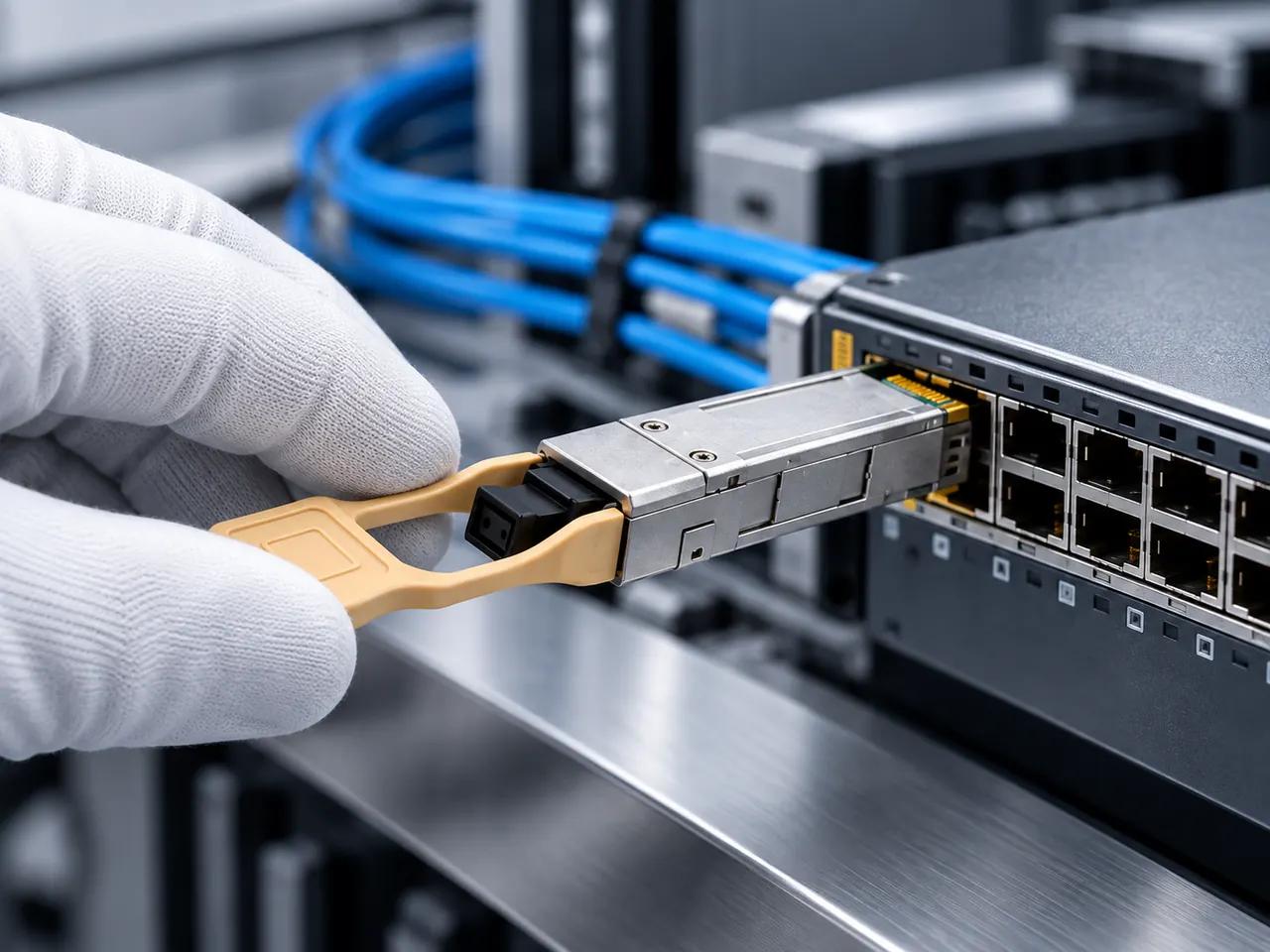
Featured
How to choose the right optical transceiver for your network
Work from host port to finished RFQ: form factor, reach class, fiber grade, loss budget, wavelength plan, temperature grade and platform coding.
Read the guide
Insights
Selection guides, link planning and procurement practice — written for engineers and buyers who have to make the decision, not for search engines.
Work from host port to finished RFQ: form factor, reach class, fiber grade, loss budget, wavelength plan, temperature grade and platform coding.
Read the guideEvaluate managed vs unmanaged ethernet switch architectures, control plane protocols, link monitoring, VLANs, and operational costs for enterprise networks.
Select the right outdoor light switch for exterior lighting. Compare enclosure ingress ratings, PoE power budgets, and industrial switching hardware.
Select the right rack mountable network switch: 19-inch mounting physics, thermal airflow direction, PoE power budgets, and transceiver port selection.
Evaluate 5 port network switch architectures, throughput calculations, PoE power budgets, and industrial DIN-rail builds for reliable edge deployments.
Single mode fiber guide detailing core size, transmission wavelengths, modal dispersion, and transceiver selection for high-speed campus and metro networks.
Design a high-performance network with switch hardware, optical transceivers, and copper ports. Learn Layer 2/3 forwarding, backplane sizing, and RFQ specs.
Evaluate 10Gb Ethernet switch architectures, SFP+ vs 10GBASE-T ports, switching fabric capacity, PoE budgets, and exact RFQ specifications for B2B networks.
Select the correct gigabit ethernet cable for your network. Compare Cat5e, Cat6 and fibre options, loss budgets, PoE limits and SFP interfaces.
Evaluate the SX SFP module for enterprise LANs. Review 1000BASE-SX optical budgets, OM1 to OM4 transmission limits, DDM diagnostics, and host compatibility.
Deploy a fiber to ethernet converter with correct optical link budgets, LFPT fault signaling, Cat6 reach limits, and modular SFP transceiver designs.
Master LC fiber connector specs, polishes, insertion loss calculations, and transceiver matching for enterprise and data centre optical networks.
An 8 port switch provides edge aggregation and endpoint distribution. Compare non-blocking throughput, PoE power budgets, SFP uplinks, and RFQ specs.
Understand network switch vs router differences across OSI layers, forwarding performance, optical interfaces, and RFQ specs for enterprise deployments.
Understand why the legacy ethernet hub became obsolete, how switching solves collision domains, and how to modernise enterprise copper and fibre networks.
Evaluate managed switch architectures, wire-speed forwarding, VLAN configurations, and optical uplink budgets with this technical procurement guide.
Master QSFP transceiver architecture, optical standards, SFF-8436 pinouts, link budgets, and breakout cabling for reliable data centre procurement.
Master duplex cable selection, fiber polarities, and transceiver optics. Compare duplex vs BiDi links with real optical budget calculations and RFQ tables.
Master SFP LC connector optical interfaces. Compare duplex and simplex types, polish geometries, insertion loss budgets, and RFQ procurement specifications.
Master single mode fiber lc connector mechanics, UPC vs APC polish, insertion loss budgets, and simplex versus duplex optical transceiver integration.
Learn how an unmanaged ethernet switch works, evaluate managed switch vs unmanaged switch trade-offs, and calculate buffer sizing for industrial networks.
Master QSFP 40G SR4 optics: IEEE 802.3ba specs, MPO-12 pinouts, OM3 and OM4 reach, 4x10G breakouts, power budgets, and B2B procurement checklist.
Compare every major OFC connector type for enterprise and telecom networks. Learn insertion loss limits, ferrule polishes, transceiver matching and RFQ specs.
Select the right ethernet switch for enterprise and industrial networks. Learn switching fabric sizing, RJ45 and SFP uplink design, PoE, and RFQ specs.
Evaluate gigabit switch hardware architectures, non-blocking backplanes, managed PoE budgets, and optical uplink modules for enterprise and edge networks.
Compare single mode vs multimode fiber core geometry, transmission distance, optical budgets, and transceiver costs to select the correct cabling plant.
AOC cables guide: compare active optical cable assemblies to DAC and discrete transceivers for power, distance, rack density, and latency performance.
Master every SFP connector interface: LC duplex, SC simplex, RJ45 copper, and internal 20-pin host edge connectors across transceivers and modem SFP links.
Master copper SFP engineering: 1000BASE-T PHY architecture, SGMII interfaces, thermal budgets, Cat6a reach limits, and procurement specifications.
Master bidirectional SFP transceivers: wavelength pairings, internal diplexer physics, link budgets, and carrier-grade procurement specifications.
Master sfp switches with our engineering guide covering port types, data rate auto-negotiation, power budgets, MSA coding, and practical procurement steps.
Comprehensive QSFP28 transceiver guide covering 100G optics specs, SR4, LR4, CWDM4 link budgets, RS-FEC rules, and data centre procurement checklists.
Evaluate the SFP 25G SR S transceiver with technical specifications, IEEE 802.3by RS-FEC rules, optical link budget calculations, and deployment standards.
Deploy every bidi transceiver correctly. Understand wavelength pairing, diplexer physics, link budget calculations, and single-strand fiber network design.
Which type of connectors do SFP transceivers use? Discover the optical and copper interfaces, from LC and SC to RJ45, with insertion loss and RFQ specs.
Deploying QSFP 100G LR4 S optics: optical link budgets, LAN-WDM wavelengths, power dissipation, host coding, and procurement specs for 10km links.
Master fiber optic ethernet cable selection for enterprise LANs, data centres, and ISP links. Compare OS2 vs OM4, calculate budgets, and specify RFQs.
An industrial switch engineering guide covering DIN rail mounting, environmental hardening, PoE power budgets, optical links, and procurement criteria.
Wavelength division multiplexing expands optical capacity without new fibre. Compare CWDM, DWDM, and transceiver optics for carrier and campus backbones.
Master DAC cable design, physical specs, power efficiency, and reach limits. Compare passive vs active copper direct attach assemblies for switches and servers.
Select the right switch for fiber optic links. Evaluate SFP cages, uplink speeds, optical budgets, and architecture for enterprise and industrial networks.
Master SFP 10G SR link budgets, multimode fibre distances, power consumption, and 10GBASE-T RJ45 copper migration options for data centre networks.
Master the SFP 10G LR optical transceiver: IEEE 802.3ae specs, link budget calculations, SMF design rules, DDM diagnostics, and procurement criteria.
Specify the right ethernet media converter for enterprise and industrial links. Compare physical layer modes, optical budgets, PoE options, and RFQ specs.
Specify the right outdoor poe switch with exact enclosure ratings, thermal operating boundaries, surge suppression calculations, and optical uplinks.
Master 1000BASE LX optical transceivers: specifications, link budget calculations, mode conditioning cables, vendor coding, and RFQ checklists.
Master fiber optic wavelengths, optical transmission windows, and singlemode optical fiber loss profiles to design high-performance optical transceiver links.
Cut cable tray congestion by 50% with the LC uniboot connector. Explore polarity reversal, airflow benefits, ferrule pitch, and transceiver integration.
A PoE switch delivers direct current and data over twisted-pair copper. Master IEEE 802.3 standards, calculate power budgets and specify uplink optics.
Master small form factor pluggable module optics. Compare SFP types, MSA specs, link budgets, EEPROM coding, and procurement checklists for switches.
Understand single mode fiber specifications, OS1 vs OS2 standards, transceiver selection, and attenuation budgets for reliable high-speed optical links.
Passive and active copper, AOC construction, reach limits per data rate, breakout options, power, bend radius and the coding both ends need.
Single-fiber BiDi links need complementary wavelengths at each end. How to record the pairing, budget the loss and keep spares usable across sites.
Read transmit power, receive power, bias current, temperature and voltage against model thresholds to separate a dirty connector from a failing module.
From link inventory to acceptance: the technical, commercial and documentation items that let a supplier quote a reviewable optical configuration first time.
OM3 and OM4 reach, MPO-12 polarity methods, pinned and unpinned ends, RS-FEC, loss budget and cleaning discipline for 100GBASE-SR4 QSFP28 links.
Structure a transceiver and cable bill of materials so it can be priced once: link references, requirement columns, spares arithmetic and version control.
Turn a sample request into a documented test: hosts to use, checks to run, soak duration, the identity string to record and how to lock the production build.
Route length, fiber grade, strand allocation, connector count, measured loss, OTDR events and polarity: the facts that decide which module a link needs.
Model datasheets, coding declarations, compliance statements, traceability, packaging specs and change notification: what to ask for before the order is placed.
How to calculate an optical link budget from launch power, receiver sensitivity, fiber attenuation, connector and splice loss, and why reach labels mislead.
A practical comparison of 100G QSFP28 variants: how SR4, PSM4, CWDM4, LR4 and single-fiber BiDi differ by fiber plant, reach, connector type and cost drivers.
10GBASE-T SFP+ RJ45 modules, optical SFP+, DAC and AOC compared on power, latency, cabling category and reach, with guidance on when each is the right choice.
Polarity methods A, B and C, Base-8 versus Base-12 trunks, pinned connectors, cassettes, inspection and cleaning, and the field mistakes that break parallel optics.
What is stored in a transceiver EEPROM, how MSA documents define it, why hosts check it, and the information a supplier needs to code modules for your platform.
Temperature grades, enclosure heat rise, surge and EMC exposure, media converter selection and PoE power budgeting for optical links outside the equipment room.
Next step
Send the architecture, the distances and the host platforms. We will work through the configuration with you.