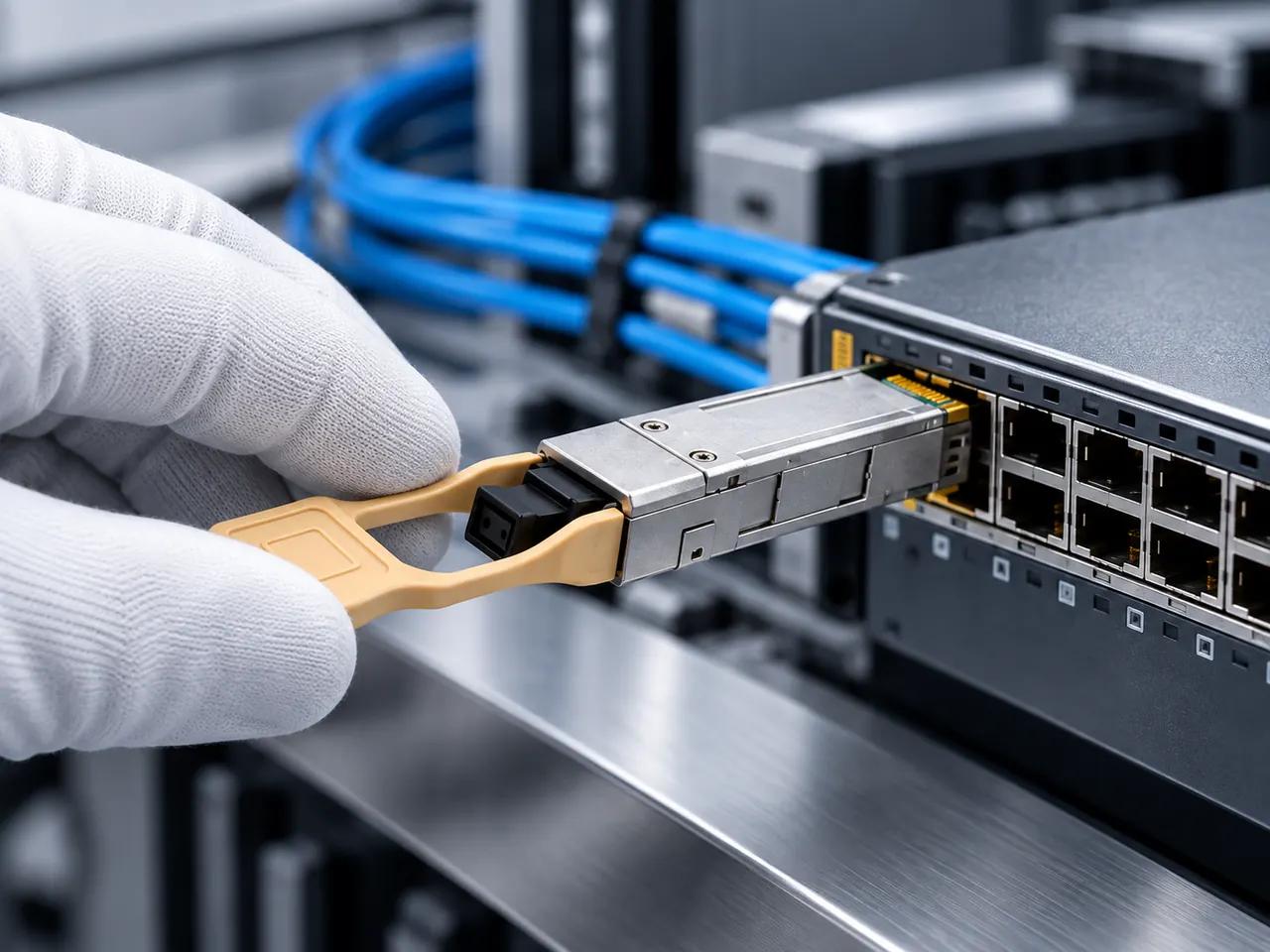

An industrial switch ensures deterministic automation and harsh-environment uptime by combining fanless conduction cooling from -40°C to +85°C, redundant DC power inputs, industrial-grade optics, and sub-20ms ring recovery protocols over hardened DIN rail enclosures.
01What is an industrial switch and how does it differ from commercial hardware?
An industrial switch is a ruggedized network bridge engineered to deliver deterministic Layer 2 and Layer 3 packet forwarding under severe operational stresses, including extreme operating temperatures, electromagnetic interference (EMI), mechanical shock, and continuous vibration. Unlike commercial enterprise switches assembled inside vented sheet-metal enclosures that rely on motorized fans, an industrial ethernet switch operates with sealed, fanless IP30, IP40, or IP67 aluminium chassis acting as thermal heatsinks. Enterprise hardware is rated for controlled environments between 0°C and 40°C, whereas an industrial network switch maintains uninterrupted throughput from -40°C to +85°C across hazardous plant floors, trackside signalling cabins, and outdoor enclosures.
The differences extend deep into power delivery, circuit isolation, and physical form factors. Commercial switches expect conditioned 100–240 V AC mains voltage delivered via an IEC C13 plug with single-point power supplies. Conversely, a hardened network switch incorporates dual redundant DC power inputs (typically 12–48 V DC or 24–57 V DC for PoE systems) using industrial screw-down terminal blocks to prevent vibration disconnects. Internal boards are built with conformal coating against humidity and airborne contaminants, while circuit lines feature high galvanic isolation rated up to 1.5 kV or 2.25 kV to neutralise ground potential differentials between remote production zones.
02Why DIN rail mounting defines edge industrial network topologies
A din rail ethernet switch is designed to attach directly to standardized 35 mm symmetrical metal mounting brackets conforming to standard EN 50022 (IEC/EN 60715). Field control cabinets, traffic management boxes, and programmable logic controller (PLC) panels do not provide standard 19-inch rack frames; they organise power supplies, safety relays, terminal strips, and microcontrollers along horizontal or vertical DIN rails. Employing a compact din rail switch allows network engineers to co-locate network aggregation hardware within centimetres of automation endpoints without requiring external mounting trays or custom brackets.
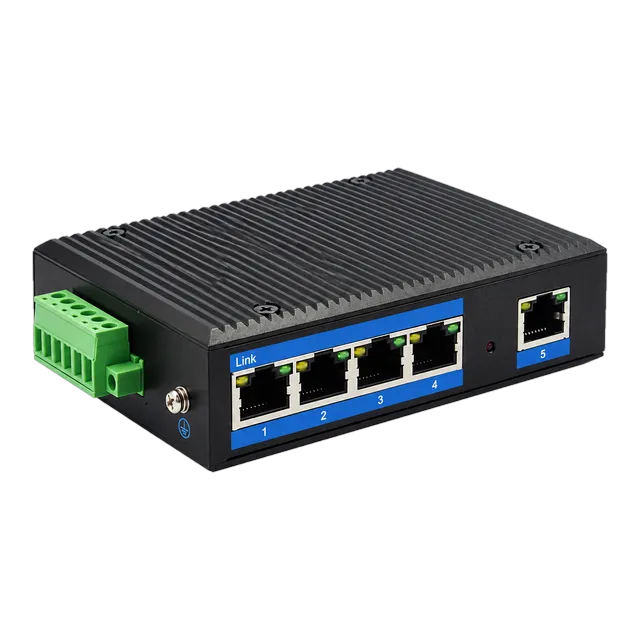
Integrating a din rail mount ethernet switch into these dense enclosures demands strict attention to physical form factors, vertical cable management, and thermal dissipation airflow. Because an unmanaged or managed din mount ethernet switch relies entirely on passive convection cooling, installers must maintain at least 50 mm of unobstructed clearance above and below the chassis heatsink fins. The top panel typically hosts redundant DC inputs, while front-facing RJ45 and SFP interfaces ensure patch cables can be routed cleanly through lateral plastic wire ducts without exceeding the minimum bend radius of shielded Category 6 or single-mode optical cabling.
03Unmanaged industrial ethernet switch vs industrial managed switch architectures
An unmanaged industrial ethernet switch provides autonomous, plug-and-play Layer 2 forwarding without software configuration, making it the most cost-effective choice for isolated sub-networks and simple sensor drop lines. It forwards standard Ethernet frames based solely on automatic MAC address learning and auto-negotiation per IEEE 802.3u and 802.3ab. For small machine enclosures with four to eight devices communicating over unsegmented subnets, an unmanaged device minimizes hardware costs and eliminates operating system vulnerability maintenance in the field.
Conversely, an industrial managed switch provides granular traffic orchestration, network security, and deterministic availability across complex facilities. A managed switch runs an integrated operating system supporting IEEE 802.1Q Virtual Local Area Networks (VLANs), port-based IEEE 802.1p Quality of Service (QoS), Simple Network Management Protocol (SNMPv1/v2c/v3), and redundant ring recovery protocols. When commissioning modern industrial control systems (ICS) running PROFINET, EtherNet/IP, or Modbus TCP, a managed industrial switch prevents multicast broadcast storms using IGMP snooping and segments critical real-time SCADA packets away from general telemetry traffic.
04Redundant ring protocols: achieving sub-20ms network recovery
Fast convergence ring protocols allow an industrial lan switch to restore physical link connectivity in under 20 milliseconds during a fiber cut or transceiver hardware failure. While traditional enterprise networks rely on IEEE 802.1D Spanning Tree Protocol (STP) with recovery times of 30 to 50 seconds, or IEEE 802.1w Rapid Spanning Tree Protocol (RSTP) which converges in 1 to 2 seconds, critical industrial automation processes cannot tolerate dropouts exceeding 50 ms without triggering automated emergency machine shutdowns or PLC fault states.
Proprietary and standardized ring topologies isolate one link as a backup path during regular operations to eliminate packet loops. When the primary fiber link is severed, the master switch unblocks the backup port, flushing MAC address forwarding databases across all transit nodes. For multi-vendor utility architectures, switches conform to ITU-T G.8032 Ethernet Ring Protection Switching (ERPS) or IEC 62439-3 Clause 4 (Parallel Redundancy Protocol, PRP) and Clause 5 (High-availability Seamless Redundancy, HSR), which duplicate frames across parallel paths to deliver zero-millisecond failover.
05Environmental hardening: temperature, ingress protection, and MTBF
A rugged ethernet switch is engineered to withstand environmental extremes that destroy standard office networking equipment within hours. Operating temperature resilience is achieved through industrial silicon rated for -40°C to +85°C, high-grade solid electrolytic or tantalum capacitors, and heavy ribbed cast-aluminium chassis that dissipate heat purely via conduction and radiant convection without moving mechanical parts. Ingress protection ratings define the barrier against particulates and water: IP30 protects against tools and solid objects larger than 2.5 mm, IP40 blocks objects larger than 1.0 mm, and IP67 provides fully submersible dust- and water-tight operation for trackside and marine setups.
Mean Time Between Failures (MTBF) for an industrial switch routinely exceeds 300,000 to 500,000 hours (calculated per Telcordia SR-332 or MIL-HDBK-217F at 25°C). The absence of cooling fans eliminates the primary mechanical failure point of network infrastructure. For engineers sourcing external field nodes, products such as the Outdoor Industrial Gigabit Ethernet Switch — 5× RJ45 Port provide wide 10–47V DC operation and robust -40°C to +85°C stability in compact terminal-block-powered formats.
06Electromagnetic compatibility and industry-specific compliance standards
An industrial network switch must maintain high electromagnetic compatibility (EMC) to operate adjacent to variable frequency drives (VFDs), large electric motors, and high-voltage switchgear without corrupting Ethernet frames. Compliance testing requires verification against IEC 61000-4-2 (Electrostatic Discharge up to 8 kV contact / 15 kV air), IEC 61000-4-4 (Electrical Fast Transient/Burst up to 4 kV on power and data lines), and IEC 61000-4-5 (Surge Immunity up to 4 kV line-to-earth). Industrial standards mandate Level 3 or Level 4 testing to guarantee packet integrity under severe electromagnetic spikes.
Different deployment sectors demand specialised vertical certifications. Substations and electrical utility automation require compliance with IEC 61850-3 and IEEE 1613, which enforce strict zero packet loss under continuous RF interference and high electrostatic discharge. Railway rolling stock and wayside signalling mandate an ethernet train switch certified to EN 50155 and EN 50121-4, handling severe mechanical shock, wide DC supply ripple, and heavy vibration. For roadside intelligent transportation systems (ITS), an ethernet switch for traffic cabinets must comply with NEMA TS2 specifications for ambient heat, vibration, and supply voltage transients.
07DIN rail PoE switch implementations and total power budget calculations
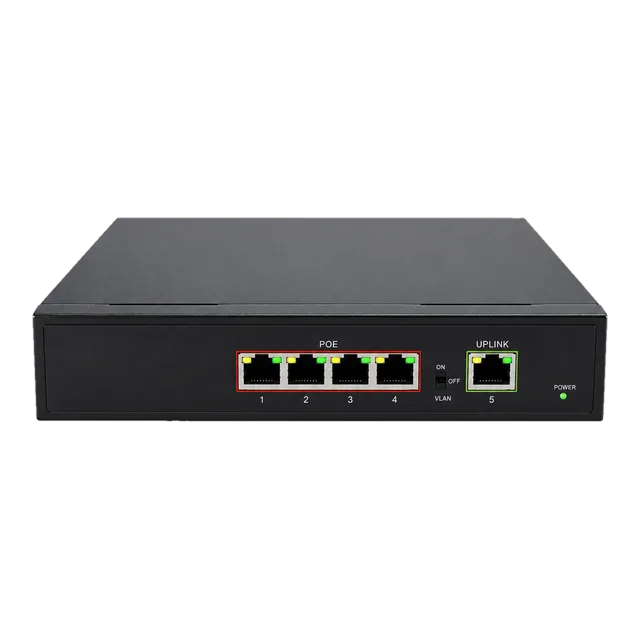
A din rail poe switch combines data switching and power delivery over copper Category 6 or Category 6a cables, powering remote industrial devices like pan-tilt-zoom (PTZ) IP surveillance cameras, access control scanners, and wireless access points without deploying separate AC wiring. Standards are governed by IEEE 802.3af (PoE, up to 15.4 W at the source), IEEE 802.3at (PoE+, up to 30.0 W), and IEEE 802.3bt (4PPoE Type 3 up to 60 W, Type 4 up to 90 W). When deploying a Gigabit PoE IP Ethernet Switch — 4 PoE Ports + 1 Uplink, systems leverage dedicated 30W IEEE 802.3af/at capabilities per port for connected field nodes.
Calculating power supply requirements for a din rail mount poe switch requires balancing device loads against DC supply capacity and copper resistance losses. Consult our detailed PoE switch standards and power budget guide for complete topological guidelines. The basic system equation is expressed as:
P_supply ≥ (∑ P_device + ∑ P_cable_loss) / Efficiency_switch + P_internal
| Standard (Clause) | Voltage Range (V DC) | Max Power at PSE (W) | Max Power at PD (W) | Pairs Used (Qty) | Typical Cable Loss (100 m) (W) |
|---|---|---|---|---|---|
| IEEE 802.3af | 44.0 – 57.0 | 15.4 | 12.95 | 2 pairs | 2.45 |
| IEEE 802.3at (Type 2) | 50.0 – 57.0 | 30.0 | 25.50 | 2 pairs | 4.50 |
| IEEE 802.3bt (Type 3) | 50.0 – 57.0 | 60.0 | 51.00 | 4 pairs | 9.00 |
| IEEE 802.3bt (Type 4) | 52.0 – 57.0 | 90.0 | 71.30 | 4 pairs | 18.70 |
08Industrial switch power supply calculation: worked engineering example
To correctly specify an external DIN rail DC power supply for a hardened network switch driving field automation, an engineer must calculate both peak and steady-state electrical consumption. Consider an industrial setup running an 8-port PoE+ DIN mount switch containing 4 connected Class 4 (IEEE 802.3at) PTZ surveillance cameras with IR illuminators and internal heaters, alongside 2 industrial wireless access points operating under IEEE 802.3af Class 3. The industrial switch itself consumes 12 W of baseline internal logic power, and internal DC-to-DC conversion efficiency operates at 88%.
- Calculate maximum PSE power requirements: 4 × 30.0 W (PoE+ ports) = 120.0 W; 2 × 15.4 W (PoE ports) = 30.8 W. Total PoE payload demand = 150.8 W.
- Calculate cable line transmission losses: Assuming 85-metre Cat6 runs (0.138 Ω/m loop resistance at 20°C): 4 × 4.1 W = 16.4 W; 2 × 1.8 W = 3.6 W. Total copper cable loss = 20.0 W.
- Factor switch internal logic and conversion losses: Power drawn through the DC bus = (150.8 W / 0.88) + 12 W = 171.36 W + 12 W = 183.36 W.
- Apply standard engineering thermal safety margin: In high ambient enclosures reaching 60°C, apply a minimum 25% safety overhead to eliminate power supply derating stress: 183.36 W × 1.25 = 229.20 W.
Based on this worked calculation, the engineer must specify a minimum 240 W, 48–55 V DC industrial DIN-rail power supply to ensure reliable camera booting and winter heating operation.
09Optical connectivity: using an industrial fiber switch for long-distance immunity
An industrial fiber switch overcomes the 100-metre physical distance barrier of copper twisted-pair cabling while providing absolute galvanic immunity against ground loops and lightning strikes in outdoor conduits. High-voltage sub-stations and expansive petrochemical facilities frequently route industrial network switch links across kilometres of inter-building ductwork where common-mode voltage differences between distant plant areas would blow copper PHY chips. Fibre optic interfaces convert electronic packets into photonic signals immune to radio frequency and electromagnetic fields.
For short runs between plant control panels, multi-mode fibre (OM3 or OM4) using 850 nm VCSEL lasers provides cost-effective connectivity up to 550 m. For long-haul links connecting industrial zones, traffic cabinets, and remote pumping stations, single-mode fiber (SMF per ITU-T G.652.D) at 1310 nm or 1550 nm is mandatory. Network engineers can learn more about transceiver form factors in our Small Form Factor Pluggable module guide to select appropriate physical layer transceivers.
10Matching industrial switches with industrial-grade optical transceivers
Plugging commercial temperature (0°C to 70°C) SFP or SFP+ transceivers into an industrial switch rated for -40°C to +85°C introduces an immediate point of failure. At sub-zero temperatures, standard laser diodes suffer wavelength drift that violates spectral masks, while high cabinet temperatures cause thermal runaway, elevating bit error rates (BER) and accelerating laser degradation. Industrial-grade optical transceivers incorporate hardened laser assemblies, specialized thermistors, and firmware-compensated bias currents that guarantee full specification conformance across the entire -40°C to +85°C industrial operating window.
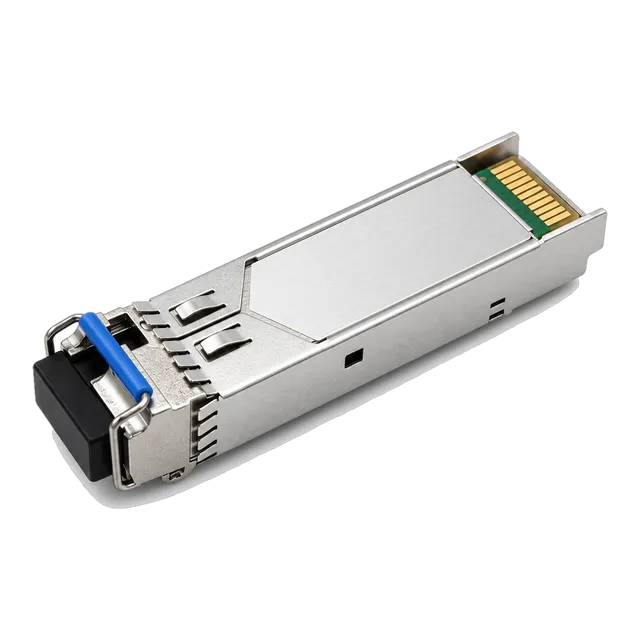
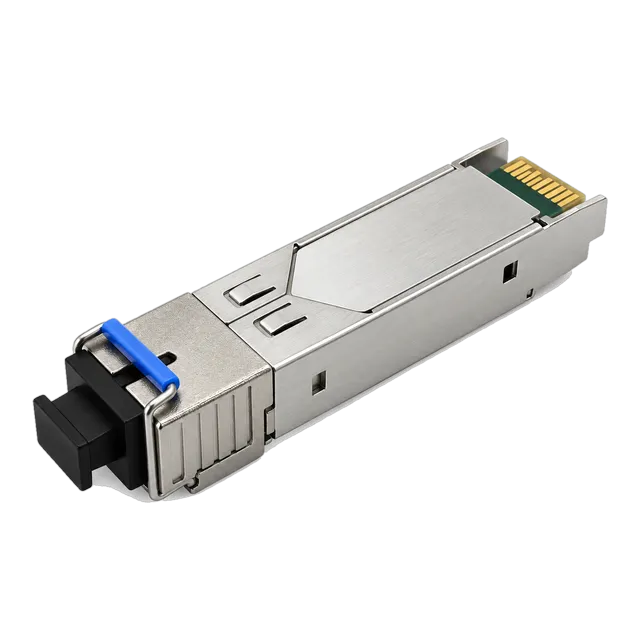
When specifying Gigabit uplinks, devices like the 1.25G Gigabit SFP Transceiver — 1000Base SM/MM, 550m to 120km deliver hardened optical connectivity across dual-fiber routes. Where physical conduit capacity is constrained to a single fiber strand, Single-Fiber BiDi optics such as the 1.25G SFP BiDi Optical Module 20km 1310nm/1550nm SC utilise Wavelength Division Multiplexing (WDM) to transmit and receive simultaneously over one single-mode core, halving cabling installation costs. To prevent optical overload on shorter links, consult our guide on calculating optical link budgets.
11Cybersecurity and segmentation: firewall ethernet switch functionality
A firewall ethernet switch bridges the functional boundary between operational technology (OT) automation systems and enterprise information technology (IT) networks while complying with IEC 62443 cybersecurity standards. Modern industrial switches no longer act as simple frame forwarders; they incorporate Layer 3 access control lists (ACLs), IEEE 802.1X port authentication, and stateful inspection firewall engines directly on DIN-rail hardware. This physical integration prevents malware from traversing the corporate intranet into critical programmable automation controllers (PACs) on the plant floor.
Implementing defense-in-depth requires segmenting internal production cells into isolated security zones. Network engineers configure hardware-based packet filtering to permit only authorized industrial protocols—such as restricting access to TCP port 502 for Modbus or TCP port 44818 for EtherNet/IP—while blocking unauthorized routing, Telnet, or unencrypted HTTP traffic. For edge installations lacking native L3 routing, pairing unmanaged field drops with an intermediate media converter allows secure fiber backhaul straight to a hardened, firewalled aggregation switch inside the main control room.
12Comparing industrial switch form factors and mounting options
Selecting the optimal mechanical enclosure for an industrial switch depends on installation real estate, port density requirements, and ambient exposure levels. Field panels, motor control centres (MCCs), and trackside locations demand distinct physical profiles.
| Switch Form Factor | Mounting Standard | Port Density Range | Typical IP Rating | Cooling Method | Primary Deployment Location |
|---|---|---|---|---|---|
| DIN Rail Compact | 35 mm DIN Rail (IEC 60715) | 4 to 16 Ports | IP30 / IP40 | Passive Convection / Heatsink | Machine control panels, traffic cabinets |
| Wall / Panel Mount | Direct Flat Plate / Flange | 4 to 24 Ports | IP30 / IP40 | Passive Convection / Heatsink | Machinery frames, shallow electrical enclosures |
| 19-Inch Rack Mount | EIA-310-D 19" 1U/2U Rack | 24 to 52 Ports | IP30 | Conduction / Passive Venting | Substation control rooms, edge data closets |
| Field Hardened IP67 | Direct Machine Mount (M12) | 8 to 16 Ports | IP67 | Cast Sealed Heatsink | Rolling stock undercarriages, wet processing plants |
13Procurement checklist: specifying an industrial switch for enterprise RFQs
When preparing an engineering request for quotation (RFQ) for an industrial switch, specifying generic consumer parameters leads to field failures and premature hardware replacement. Sourcing engineers and network architects must provide switch manufacturers with precise environmental, electrical, and optical operational thresholds. Use the following structured technical checklist when issuing your next competitive bill of materials (BOM):
- Mounting & Form Factor: Confirm 35 mm DIN rail mount (per IEC 60715) or 19-inch rackmount chassis, including enclosure dimensions and front-facing connector orientation.
- Temperature & Ingress: Specify operating range (-40°C to +85°C) and ingress protection (IP30, IP40, or IP67 waterproof).
- Power Input Specifications: Define input voltage range (e.g., dual redundant 12–48 V DC or 48–57 V DC for PoE), reverse polarity protection, and removable terminal block pinouts.
- Port Allocation & Media Types: State exact quantities of copper RJ45 ports (10/100/1000Base-T) and SFP/SFP+ optical cages (1.25G / 10G) required.
- PoE Budget Requirements: If ordering a din rail mount poe switch, specify total power budget (W), IEEE standard conformance (802.3af/at/bt), and per-port power pinning.
- Resiliency & Network Protocols: Mandate ERPS (ITU-T G.8032) or proprietary ring failover (<20 ms), IGMP Snooping, IEEE 802.1Q VLANs, and SNMPv3 secure management.
- Regulatory Standards & Certifications: Require test certificates for EMC (IEC 61000-4 series), Rail (EN 50155 / EN 50121-4), Substation (IEC 61850-3 / IEEE 1613), or Roadside (NEMA TS2).
14How to validate optical transceiver compatibility before site deployment
Validating transceiver interoperability before mounting an industrial switch at a remote substation or highway gantry prevents costly truck rolls and commissioning delays. Modern industrial managed switches enforce vendor coding checks within their network operating system, reading internal Multi-Source Agreement (MSA) EEPROM tables per SFF-8472 specifications. If a transceiver’s Vendor ID or checksum registers do not align with the switch’s expected host encoding, the port may disable the laser or report an unauthorized module fault.
Procuring switches alongside factory-coded industrial optics ensures day-one reliability. Transceivers must support Digital Diagnostic Monitoring (DDM / DOM), allowing technicians to read real-time operational parameters directly over the switch CLI or SNMP manager. Key monitored values include laser bias current, internal module temperature, operating voltage, transmitted optical power (Tx), and received optical power (Rx). Reading these telemetry streams allows preventive maintenance crews to identify degraded fiber paths or dirty optical connector end-faces before packet loss impacts the industrial network.
15Frequently asked questions
What is an industrial switch?
An industrial switch is a ruggedized network switch engineered for harsh environments. It features fanless conduction cooling, wide operating temperature support from -40°C to +85°C, redundant DC power inputs, DIN rail mounting, and high electromagnetic immunity against heavy industrial electrical noise.
Why do industrial switches use DIN rail mounting?
Industrial switches use DIN rail mounting to install directly onto standard 35 mm metal rails inside automated electrical cabinets, roadside traffic enclosures, and factory control panels, placing network connectivity adjacent to PLCs and power supplies without requiring bulky 19-inch server racks.
Can commercial optical transceivers be used in an industrial switch?
Commercial optical transceivers should not be used in an industrial switch. Standard optics are rated only for 0°C to 70°C and suffer severe laser drift, elevated bit errors, or complete transceiver failure when exposed to extreme cabinet temperatures between -40°C and +85°C.
What is the difference between an unmanaged and managed industrial switch?
An unmanaged industrial switch offers basic plug-and-play Layer 2 forwarding without software configuration. A managed industrial switch provides advanced software controls, including VLAN traffic segmentation, QoS priority queuing, SNMP monitoring, rapid ring recovery protocols (<20 ms failover), and cybersecurity port controls.
What voltage power supply does an industrial DIN rail PoE switch require?
An industrial DIN rail PoE switch typically requires a 48 V to 57 V DC external power input to satisfy IEEE 802.3af (15.4 W), IEEE 802.3at (30 W), or IEEE 802.3bt (up to 90 W) power delivery specifications over Cat6 Ethernet cables.
How fast do industrial redundant ring protocols recover from a link failure?
Industrial redundant ring protocols such as ITU-T G.8032 ERPS, MRP, or proprietary fast-recovery rings restore network packet forwarding in under 20 milliseconds, preventing process disruptions and emergency shutdowns across critical automation, railway signalling, and utility control networks.
Technical review note: confirm model-specific specifications with the product datasheet and the intended host documentation. Product images and application photographs are illustrative.
Discuss this with our team