
An 8 port switch delivers optimal edge efficiency only when backplane bandwidth matches full-duplex wire speed (16 Gbps for GbE) and the continuous PoE power budget accounts for real endpoint draw under thermal derating.
018 port switch selection criteria for enterprise and industrial networks
An 8 port switch operates as an edge distribution bridge connecting workstations, IP cameras, wireless access points, or industrial controllers to the wider local area network. When evaluating an 8 port ethernet switch for enterprise or factory floor deployments, engineers must inspect the internal switching fabric capacity, port forwarding architecture, and power supply headroom rather than relying on faceplate port counts alone.
Deploying an 8 port network switch requires matching the physical interface mix to the downstream endpoints. While legacy installations relied on Fast Ethernet (100BASE-TX), modern local area networks require an 8 port gigabit ethernet switch supporting IEEE 802.3ab over Category 5e, Category 6, or Category 6a structured copper cabling. For networks integrating optical trunking or long-distance backhauls, hybrid models complement copper interfaces with small form-factor pluggable (SFP) sockets governed by IEEE 802.3z.
Procurement teams sourcing from commercial and industrial ethernet switches must also establish whether the target environment demands a hardened chassis with convection cooling, or whether a standard 8 port desktop gigabit switch is sufficient. Factoring in management protocols, media conversion requirements, and total power delivery prevents premature hardware replacement when network topologies expand.
02Non-blocking switching fabric and wire-speed packet throughput calculation
A non-blocking switching fabric guarantees that an 8 gigabit port switch forwards packets at maximum physical wire speed simultaneously across every port without packet loss. To establish whether a switch is non-blocking, calculate both the switching capacity (backplane bandwidth) and the forwarding rate in million packets per second (Mpps).
For an 8 port 1gbps switch operating in full-duplex mode, each port transmits at 1 Gbps and receives at 1 Gbps, yielding 2 Gbps of aggregate bandwidth per physical interface. The theoretical backplane bandwidth requirement is derived as follows:
- Total Switching Capacity = 8 ports × 1 Gbps × 2 (full duplex) = 16 Gbps
Forwarding rate calculations rely on the minimum Ethernet frame size under IEEE 802.3: a 64-byte frame plus 8 bytes of preamble and start-of-frame delimiter (SFD), accompanied by a 12-byte inter-packet gap (IPG), totalling 84 bytes (672 bits) per frame transmission. The wire-speed packet rate for a single 1 Gigabit switch 8 port interface is:
- 1,000,000,000 bits per second / 672 bits per packet = 1,488,095 packets per second (1.488 Mpps)
- Total Forwarding Rate = 8 ports × 1.488 Mpps = 11.904 Mpps
If the hardware data sheet states a switching capacity below 16 Gbps or a forwarding rate below 11.9 Mpps, internal oversubscription exists. In networks handling bursty traffic, such as high-frame-rate IP video or uncompressed audio-over-IP, oversubscribed architectures introduce buffer bloat, frame drops, and latency jitter.
03Comparing 8 port managed ethernet switch architectures with unmanaged hardware
An 8 port managed ethernet switch includes an onboard microprocessor running firmware that exposes management protocols such as SNMP, SSH, and IEEE 802.1Q VLAN configuration, whereas an 8 port unmanaged switch operates purely as a plug-and-play transparent bridge. The decision between managed and unmanaged units depends on security, traffic segmentation, and network visibility requirements.
An 8 port unmanaged ethernet switch maintains an internal Media Access Control (MAC) address table—typically 4K to 8K entries—and forwards frames based solely on destination MAC lookups. It provides no mechanism for broadcast containment or traffic prioritisation. Conversely, a managed 8 port gigabit ethernet switch allows administrators to segregate operational technology (OT) traffic from enterprise traffic, shape latency-sensitive streams, and detect transmission faults using Syslog or Simple Network Management Protocol (SNMPv3).
| Feature Parameter | 8 Port Unmanaged Switch | Smart-Managed (Web-Smart) | Fully Managed 8 Port Switch |
|---|---|---|---|
| VLAN Support (IEEE 802.1Q) | None (Single Broadcast Domain) | Basic Port/Tagged (up to 64 IDs) | Full Range (4,094 IDs, QinQ) |
| Spanning Tree (STP/RSTP/MSTP) | None / Transparent forwarding | RSTP (IEEE 802.1w) | STP, RSTP, MSTP (IEEE 802.1s) |
| Quality of Service (QoS) | Fixed hardware priority queues | 4 to 8 Queues (CoS / DSCP) | Advanced shaping, ACL policing |
| Link Aggregation (IEEE 802.3ad) | Unsupported | Static trunking | Dynamic LACP with failover |
| Out-of-Band & CLI Access | None | Web GUI only | RS-232/RJ45 Console, SSH, Web |
| IGMP Snooping (v1/v2/v3) | Floods multicast as broadcast | IGMP v1/v2 basic querier | IGMP v1/v2/v3 fast-leave, MVR |
For additional architectural depth on switch fabrics, consult our guide on gigabit switch architecture and selection.
048 port gigabit ethernet poe switch power budgeting and standards
An 8 port gigabit ethernet poe switch injects DC power over balanced twisted-pair cabling to energise remote Powered Devices (PDs) such as security cameras, access points, and VoIP terminals without local mains power supplies. Sizing an 8 port switch poe gigabit model requires calculating the combined power requirements across all ports against the Power Sourcing Equipment (PSE) power supply rating.
The Institute of Electrical and Electronics Engineers defines three primary standards relevant to 8 port gb poe switch hardware:
- IEEE 802.3af (PoE): Supplies up to 15.4 W at the PSE port, delivering a guaranteed 12.95 W at the device over a 100-metre Cat5e channel at 44.0–57.0 V DC.
- IEEE 802.3at (PoE+): Delivers up to 30.0 W per port, guaranteeing 25.5 W at the device across 50.0–57.0 V DC.
- IEEE 802.3bt (4PPoE / PoE++): Type 3 delivers up to 60 W (51 W at PD), and Type 4 delivers up to 90 W (71.3 W at PD) using all four twisted pairs.
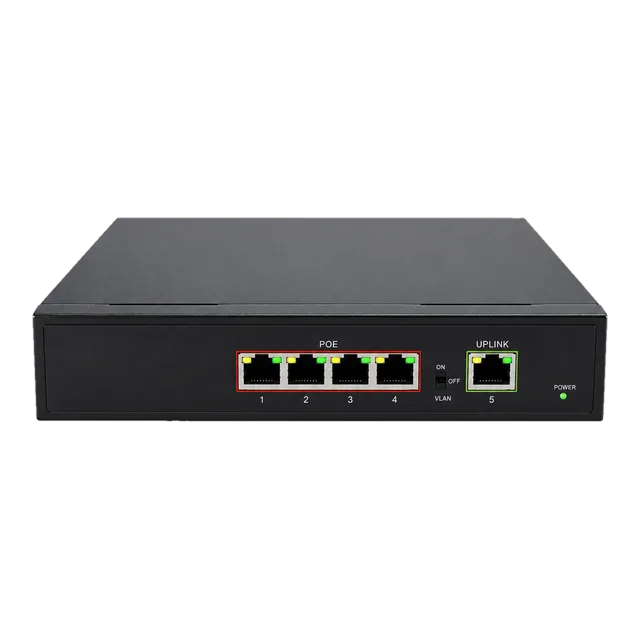
An 8 port poe unmanaged switch equipped with a modest 65 W internal power supply cannot sustain eight Class 4 (PoE+) devices running simultaneously, as 8 × 30 W equals 240 W. In that scenario, the switch will shut down lower-priority ports or reset under peak load. For edge installations with mixed endpoints, products like the Gigabit PoE IP Ethernet Switch resolve this challenge by pairing dedicated PoE ports with dedicated non-powered uplink ports to conserve power headroom. For comprehensive power budget calculations, reference our PoE switch standards and power budget guide.
05Uplink architectures: dedicated SFP ports versus copper combination interfaces
Uplink ports on an 8 port network switch gigabit connect the local access tier to distribution switches or core aggregation routers over greater distances than copper reach limits allow. Manufacturers implement uplinks as either combo ports or dedicated optical interfaces.
A combo port (shared port) pairs an RJ45 copper jack with an SFP cage internally connected to the same MAC serializer/deserializer (SerDes) channel. If an optical transceiver is seated in the SFP slot, the corresponding copper port is automatically disabled, meaning an 8 port switch with two combo ports functions as an 8-port switch in total, not a 10-port switch. Dedicated uplinks, conversely, provide independent SerDes lanes, allowing eight full access ports alongside two dedicated uplink ports (an 8+2 architecture).
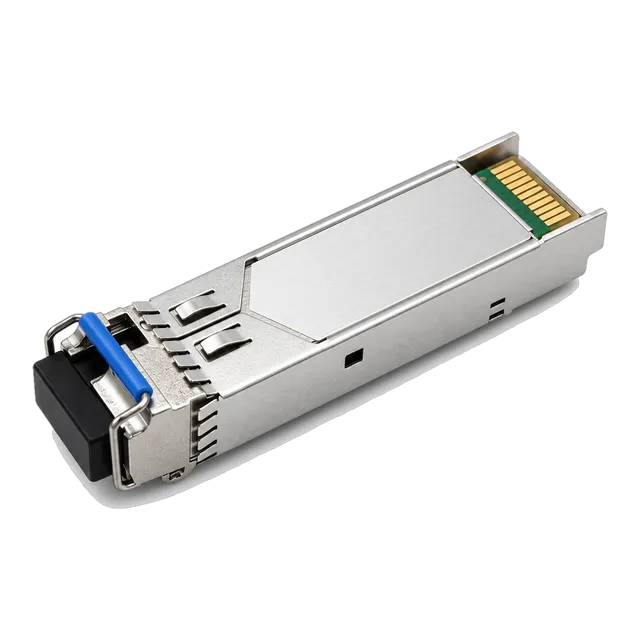
When long fiber runs connect building distribution frames (BDF) to the main facility distribution frame (MDF), seating a 1.25G Gigabit SFP Transceiver into an SFP uplink port enables single-mode optical links spanning up to 20 km or 40 km under IEEE 802.3z 1000BASE-LX standards, completely immune to electromagnetic interference.
06Industrial and outdoor deployments for 8 port network switch hardware
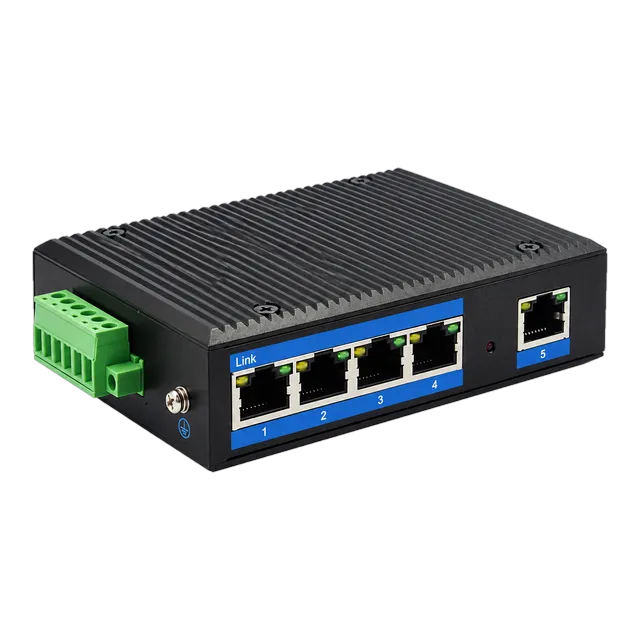
Deploying an 8 port network switch in roadside cabinets, industrial plant floors, or utility substations demands environmental hardening that surpasses standard commercial desktop hardware specifications. Industrial switches replace plastic housings and internal cooling fans with ruggedised metal chassis designed for passive thermal dissipation and DIN-rail mounting.
Commercial switches operate reliably within a 0°C to 40°C temperature envelope. Industrial units, such as the Outdoor Industrial Gigabit Ethernet Switch, are engineered to function across an extended range of -40°C to +85°C. Key engineering criteria for ruggedised environments include:
- Redundant DC Power Inputs: Industrial units feature dual terminal block power inputs (typically 12–48 V DC or 48–57 V DC for PoE) to allow connection to redundant power rails or battery backups.
- Electromagnetic Compatibility (EMC): Compliance with IEC 61000-4-2 (Electrostatic Discharge), IEC 61000-4-4 (Electrical Fast Transient/Burst), and IEC 61000-4-5 (Surge Immunity up to 6 kV on copper ports).
- Ingress Protection: IP30 or IP40 rated aluminium enclosures that prevent the ingress of airborne debris, swarf, and accidental tool contact without using failure-prone cooling fans.
- Shock and Vibration Resistance: Conformance to IEC 60068-2-6 (vibration) and IEC 60068-2-27 (shock) ensures continuous uptime alongside heavy industrial machinery.
07VLAN segmentation, QoS, and multicast handling on edge switches
A managed 8 port gigabit ethernet switch improves local network efficiency by isolating broadcast domains and applying prioritisation rules to mixed-traffic payloads. Without virtual local area networks (VLANs), every broadcast packet transmitted by an endpoint—such as ARP queries or DHCP discoveries—is replicated across all eight ports, consuming bandwidth on lower-speed links.
Implementing IEEE 802.1Q tagged VLANs allows engineers to segment ports into isolated broadcast domains, separating sensitive corporate systems, IP voice, and surveillance streams onto distinct subnetworks. For real-time applications, Quality of Service (QoS) using IEEE 802.1p Class of Service (CoS) or Differentiated Services Code Point (DSCP) mapping ensures that voice and video frames occupy high-priority egress queues, avoiding dropped packets when interfaces experience momentary congestion.
In video distribution networks, unmanaged switches treat IP multicast packets as unknown broadcast frames, flooding every port and saturating attached devices. A poe switch 8 port managed platform running IGMP snooping (Internet Group Management Protocol) inspects multicast Join and Leave reports, ensuring that high-bandwidth camera feeds are only forwarded to ports hosting registered multicast receivers. For guidance on multi-switch VLAN routing, view our ethernet switch selection and RFQ guide.
08Physical mounting options: 8 port desktop gigabit switch versus 19-inch rackmount
An 8 port desktop gigabit switch features a compact form factor designed for shelf, under-desk, or wall placement, whereas rackmount variants fit standard 19-inch equipment racks. Physical housing dimensions, port orientations, and power supply locations dictate how the hardware integrates into existing infrastructure.
Desktop switches generally measure between 130 mm and 220 mm in width, employing an external AC/DC desktop power brick to minimise the unit's thermal footprint. While convenient for home offices or small telecommunications closets, external adapters introduce potential single points of failure if knocked loose in active environments.
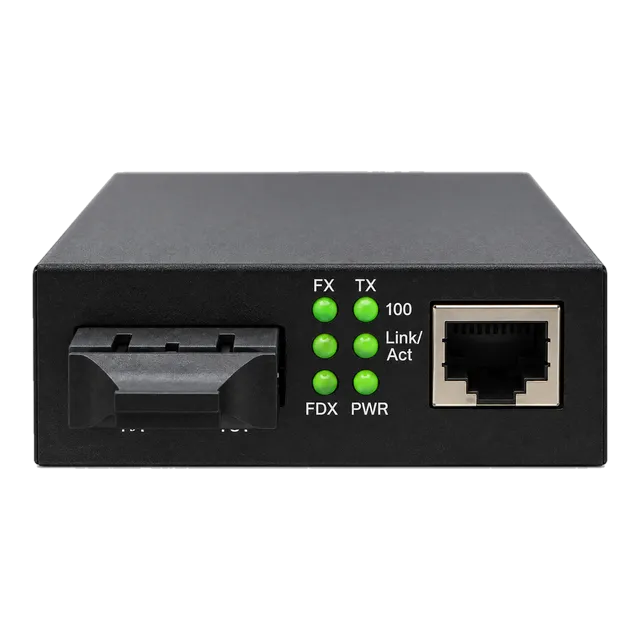
Where 8 port switches are installed in structured equipment rooms, engineers should specify units with integrated 19-inch rackmount ears or optional DIN-rail clips. Rack-mountable variants incorporate internal power supplies with standard IEC C14 receptacles, facilitating clean cable dressing and direct connection to rack-mounted uninterruptible power supplies (UPS). In dense field enclosures where space is constrained, mounting a DIN-rail unit or using a compact 1.25G SFP UTP PoE Media Converter can bridge copper endpoints back to central switches without requiring dedicated rack shelves.
09Diagnosing port negotiation, duplex mismatches, and cable faults
Port autonegotiation failures and physical layer cabling defects represent the majority of connectivity failures on an 8 port gbe switch. Under IEEE 802.3u and 802.3ab standards, endpoints exchange Fast Link Pulses (FLP) to negotiate line speed, duplex status, and master/slave clocking over copper channels.
- Duplex Mismatch Identification: If one side of a 100BASE-TX link is statically configured to full-duplex while the switch port is set to autonegotiate, the switch falls back to half-duplex. The link establishes, but sustained throughput generates excessive late collisions, CRC alignment errors, and severe packet degradation.
- Gigabit Auto-Negotiation Mandatory Rules: IEEE 802.3ab strictly requires autonegotiation for 1000BASE-T to establish clock synchronization (Master/Slave roles) across all four wire pairs. Forcing 1 Gbps statically on an 8 port ethernet switch port often causes link flaps or total failure to establish link.
- Time-Domain Reflectometry (TDR) Diagnostics: Many managed 8 port switches incorporate virtual cable testing. TDR transmits electrical pulses down each twisted pair, measuring the impedance discontinuity reflection to report the exact distance in metres to an open circuit, short circuit, or split pair.
- Optical Link Diagnostics: When using SFP uplinks, verify optical power using Digital Diagnostic Monitoring (DDM / DOM) compliant with SFF-8472 to confirm received optical power (Rx) falls well above the receiver sensitivity threshold and below saturation limits.
10Technical RFQ checklist for procuring an 8 port switch
Procuring an 8 port switch for commercial, enterprise, or industrial infrastructure requires specifying precise electrical, physical, and optical parameters to prevent receiving under-specified consumer equipment. Copy the following engineering specifications directly into your Request for Quotation (RFQ) documentation.
| Engineering Parameter | Specification Baseline | Target Requirement for Deployment |
|---|---|---|
| Port Density & Media | 8 × 10/100/1000BASE-T RJ45 | Optional: +2 × 1.25G SFP dedicated uplinks |
| Switching Performance | Non-blocking wire-speed | ≥ 16 Gbps switching fabric, ≥ 11.9 Mpps forwarding |
| Packet Buffer Memory | Shared on-chip memory | ≥ 1.5 Mbits to prevent burst packet loss |
| MAC Table Capacity | Hardware MAC storage | ≥ 8K MAC entries with configurable aging timer |
| PoE Capability & Budget | IEEE 802.3af/at (Type 1 / Type 2) | Minimum 120 W total PoE budget (≥ 15 W/port continuous) |
| Management Protocols | Layer 2 Management | SNMPv2c/v3, SSHv2, HTTPS, Syslog, IEEE 802.1Q, IGMPv3 |
| Operating Temperature | Standard or Industrial | Commercial: 0 to 40°C; Industrial: -40 to +75°C |
| Mounting & Power Supply | Enclosure format & input | 19-inch rack-mount or DIN-rail; Dual redundant DC inputs |
| Regulatory Compliance | Safety & Emissions | CE, FCC Part 15 Class A, RoHS, IEC 62368-1 |
Submitting an RFQ with defined switching fabric throughput, thermal tolerances, and PoE power budgets ensures that suppliers quote hardware capable of handling mission-critical enterprise workloads.
11Frequently asked questions
What is the difference between an 8 port switch and an 8 port hub?
An 8 port switch forwards Ethernet frames selectively based on destination MAC addresses, isolating collisions to individual ports. An 8 port hub repeats incoming electrical signals across all ports simultaneously, creating a single shared collision domain that severely degrades throughput and network security.
Can an 8 port gigabit switch operate at 100 Mbps or 10 Mbps?
Yes, an 8 port gigabit switch features triple-speed autonegotiating ports supporting 10BASE-T, 100BASE-TX, and 1000BASE-T. Interfaces automatically detect the connected endpoint's capability and adjust transmission speed and duplex mode to ensure full backward compatibility.
What power budget is needed for an 8 port PoE gigabit switch?
An 8 port PoE switch requires a minimum power budget of 60 W to 120 W for typical IP phones and basic cameras (IEEE 802.3af). For powering high-draw 802.3at PoE+ devices such as PTZ cameras or Wi-Fi 6 access points across all ports, specify a budget of 240 W.
Why does an 8 port switch need 16 Gbps switching capacity?
Each gigabit port transmits 1 Gbps and receives 1 Gbps simultaneously in full-duplex mode, equating to 2 Gbps per port. Multiplying 2 Gbps across all 8 ports yields 16 Gbps, which is required to prevent internal bottlenecks during full-load forwarding.
What is the benefit of SFP uplink ports on an 8 port switch?
SFP uplink ports allow the switch to connect over optical fiber cables spanning up to 80 km or more, exceeding the strict 100-metre physical limitation of copper Category cabling. Optical uplinks also provide total immunity to high-voltage ground loops and electromagnetic interference.
Does an 8 port unmanaged switch require any software configuration?
No, an 8 port unmanaged switch requires zero software configuration. It automatically populates its internal MAC address forwarding table upon connection and begins bridging network traffic instantly as soon as power and network cables are plugged in.
Technical review note: confirm model-specific specifications with the product datasheet and the intended host documentation. Product images and application photographs are illustrative.
Discuss this with our team