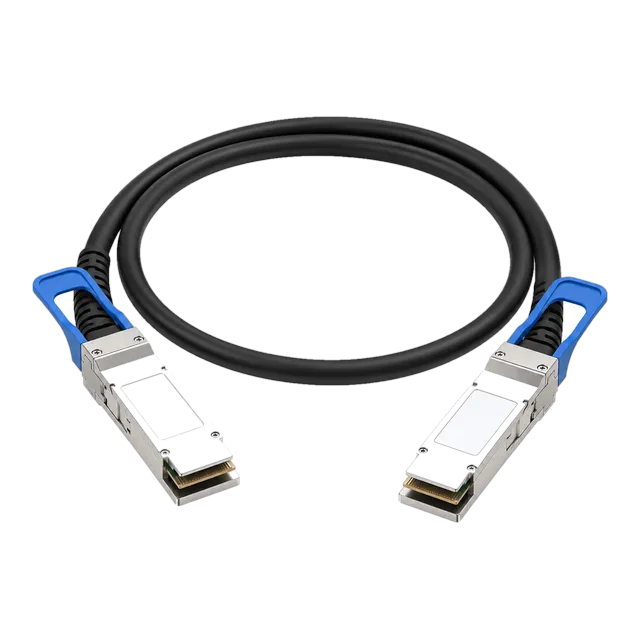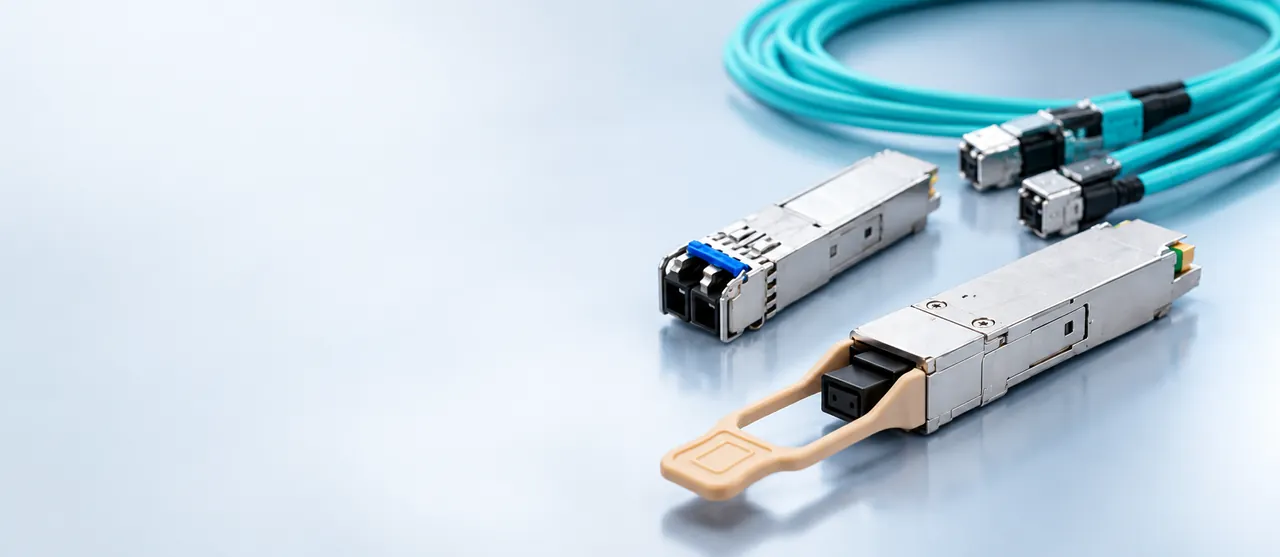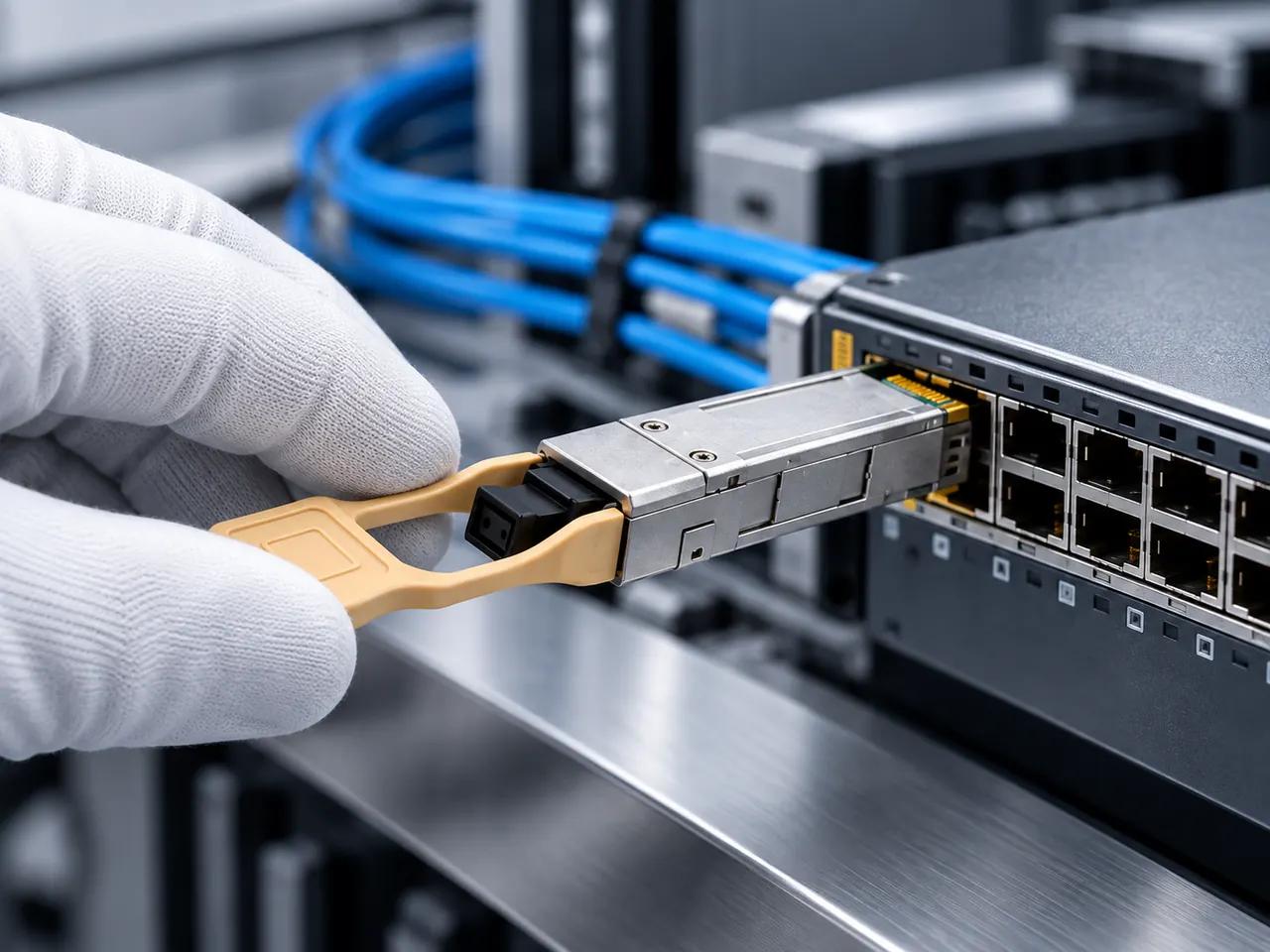

DAC suits sub-five-metre links inside a rack where weight and bend radius are manageable; AOC covers the same role across rows, and both fix length and coding at purchase.
01What the two assemblies actually are
A direct attach copper cable is a twinaxial copper assembly with a transceiver housing permanently attached at each end. There is no laser and no optical connector; the electrical lanes of the host run straight down the copper. An active optical cable is an optical assembly with transceiver electronics and short-wavelength optics permanently attached at each end, usually over OM3 multimode fiber with VCSEL sources, as in the High Speed 10G SFP+ AOC Active Optical Cable in our catalog. Neither assembly can be re-terminated, and neither exposes a serviceable optical interface. That single property drives most of the differences that follow: length, coding and connector type are all fixed at the moment of purchase, so an error in the order becomes a cable that cannot be reused rather than a module that can be moved.
02Passive and active direct attach copper
Passive DAC contains no signal conditioning. The host serialiser and deserialiser drive the copper directly, which keeps power consumption close to zero and latency at the propagation delay of the cable, but limits usable length because the copper attenuates and distorts the signal. The 100G QSFP28 to QSFP28 Passive Direct Attach Copper Cable in our catalog is listed with AWG30, AWG28 and AWG26 conductor options at 1, 3 and 5 metres. Active DAC adds equalisation or retiming electronics in the housing, which restores the eye at longer lengths at the cost of some power and a small added latency. As a rule, the higher the lane rate the shorter the passive reach, so a length that is comfortable at 10 Gb/s may be marginal at 25 Gb/s per lane. Confirm the listed length options per model rather than assuming a family covers them all.
03Conductor gauge, weight and bend radius
Gauge is not a detail. A thicker conductor such as AWG26 carries the signal further but produces a heavier, stiffer cable with a larger minimum bend radius, while AWG30 is thinner and more flexible but has a shorter usable reach. In a densely populated top-of-rack switch, thirty or forty stiff assemblies can obstruct airflow at the faceplate, strain cage latches, and make individual port service difficult. Plan the cable route before choosing the gauge: measure the actual path over cable managers rather than the straight-line distance, allow slack for the switch to slide forward on rails, and check the manufacturer's minimum bend radius against the tightest turn in the route. Where the path is long or congested, an AOC of the same length is usually lighter and easier to dress, which is often a better reason to choose one than the reach figure alone.
04Where AOC fits between DAC and pluggable optics
An AOC occupies the range where copper runs out but structured fiber is more effort than the link deserves. Typical catalog ranges start at two metres and extend to tens of metres, with our 10G SFP+ AOC listed at 2 to 20 metres and customisable. It weighs far less than copper of the same length, is insensitive to electromagnetic noise, and needs no cleaning because the optical interface is sealed inside the housing. In exchange it draws power like a pair of short-reach modules, cannot be repaired, and is vulnerable to crushing or over-tight bends during installation. Choose AOC for cross-rack and cross-row links inside a controlled room, and choose discrete modules with patch cords once the link crosses a patch panel, leaves the room, or needs to be reconfigured more than occasionally.
05Breakout assemblies and what the host must support
Breakout cables split a high-rate port into several lower-rate ports: a QSFP+ end into four SFP+ ends, or a QSFP28 end into four SFP28 ends. They are attractive for server connectivity because a single switch port serves four hosts, but they are entirely dependent on host support. The port must be configurable into breakout mode, the platform must permit that mode on that specific port, and neighbouring ports in the same group are often disabled or constrained as a result. Some platforms also require a reload for the mode change to take effect. Before ordering breakout assemblies, confirm in the platform documentation which ports support breakout, what the resulting port numbering is, and how many breakout ports the forwarding hardware allows in total. State the required breakout configuration explicitly in the request so the correct assembly is quoted.
06Coding is required at both ends
Each end of a DAC or AOC contains its own EEPROM and is read independently by the device it plugs into. When the two ends of a link land on different platforms, the assembly has to be coded for both, and that is a manufacturing decision made before the cable is built rather than something adjustable later. Say in the request which platform is at each end, including software version, because behaviour differs between releases. Where both ends are the same platform, say so as well, since it simplifies the build. Approval and certification by any host manufacturer is not something a cable supplier can represent; the assurance that matters is a sample tested in the exact pair of devices, with the port coming up and staying up under load, before the production quantity is released.
07Signal integrity and forward error correction
At 25 Gb/s per lane and above, forward error correction is part of the link rather than an optional extra. Ethernet variants at those rates specify Reed-Solomon FEC, and copper assemblies rely on it to deliver the specified bit error ratio at the longer end of their range. What this means in practice is that the host must have FEC enabled and configured consistently at both ends: a mismatch between FEC modes is a common cause of a link that either refuses to come up or comes up with a persistent error count. Record the FEC mode expected on each port type as part of the design, and include a check of FEC corrected and uncorrected counters in your acceptance test. A link that is up but accumulating uncorrected codewords is not a healthy link.
08Power, latency and thermal behaviour
Passive DAC draws essentially no port power and adds no processing delay, which is why it remains popular for dense server attachment even as rates rise. Active DAC and AOC both draw power comparable to short-reach modules and dissipate it at the faceplate. When a switch is fully populated with active assemblies, faceplate heat and airflow obstruction combine, and both should be considered against the platform's stated environmental limits. Our listed DAC and AOC assemblies carry a commercial 0 to 70 degrees Celsius operating range, so cabinets that run hot need either better airflow management or a different plan. Latency differences between the three options are small in absolute terms and rarely decide an enterprise design, but they can matter in trading and high performance computing environments where every link in the path is budgeted.
09Length discipline and stock strategy
Because length is fixed at purchase, ordering assemblies is a measuring exercise rather than a specification exercise. Walk the intended route, follow the cable managers, allow for equipment that slides on rails, and add a realistic service loop; then round up to the next standard length rather than choosing the closest. Over-length cables waste space and obstruct airflow, but under-length cables are unusable. Standardise on as few lengths as the layout allows, which makes spares interchangeable across racks. Hold spares by length and by coding combination, not merely by data rate, and label the stock accordingly. Where a rollout spans several room layouts, it is often cheaper overall to standardise racks so that one or two lengths cover the majority of links, rather than to order a long tail of single-piece lengths.
10When to use discrete optics instead
Some situations argue against a permanently terminated assembly regardless of cost. Links that pass through a patch panel, a cross-connect or a building entrance should use discrete modules and patch cords, because the assembly cannot be broken at the panel. Links in an environment that may be re-racked frequently benefit from modules that can be redeployed independently of the cable. Links that need DDM data for remote diagnosis are better served by optics, since the diagnostic information available from a copper assembly is minimal. Finally, if the same link type will later need to run further, discrete optics let you change only the module. A practical rule is that a cable assembly should stay inside one room and preferably inside one row; anything beyond that should be built from separable components.
11Acceptance testing on delivery
Test assemblies as they arrive rather than at the moment of installation. Plug a sample of each batch into the intended platforms, confirm the port comes up at the expected speed without manual coaxing, read the interface counters after a soak period of several hours under traffic, and check FEC counters where applicable. For AOC, confirm the diagnostic data the module exposes and record it as a baseline. Inspect the housings for cage latch damage and the cable jacket for crush marks from shipping. Keep the batch or lot reference with the test record so that a later failure can be traced to a shipment. This costs a few hours per delivery and is far cheaper than discovering a batch problem during a maintenance window with the change already approved.
12What the request for quotation should contain
For each distinct assembly, state: type, whether passive DAC, active DAC or AOC; data rate and connector at each end, for example QSFP28 to QSFP28 or QSFP28 to four SFP28; required length after route measurement; conductor gauge or fiber type if you have a preference; the host platform and software version at each end for coding; temperature grade; quantity with spares; and required labelling. Add commercial terms: delivery date, destination, incoterm, packaging, and whether samples are needed before the production order. Ask for the model datasheet covering the exact length and gauge quoted, since reach and electrical characteristics vary within a family, and listed specifications must be confirmed per model. A request written this way can be quoted once rather than negotiated over several rounds of clarification.
13Frequently asked questions
What is the maximum length for a passive DAC cable?
It depends on the lane rate and the conductor gauge rather than on a single universal figure, and the shorter reaches apply as lane rate increases. Our 100G QSFP28 passive DAC is listed at 1, 3 and 5 metres with AWG30, AWG28 and AWG26 options. Check the length and gauge combination on the model datasheet, and confirm that the host platform supports passive copper on that port.
Should I choose DAC or AOC for a 10 metre link?
At ten metres passive copper is generally out of range at 25 Gb/s per lane and marginal at 10 Gb/s, so an AOC is usually the practical choice. AOC is also lighter and easier to route than heavy-gauge copper at that length. Confirm that the length is available as a standard build, and measure the true cable path rather than the straight-line distance before ordering.
Do DAC cables need to be coded for both switches?
Yes. Each end has its own EEPROM and is read by the device it plugs into, so an assembly linking two different platforms must be coded appropriately at each end. That is decided when the cable is built and cannot be changed afterwards. State both platforms and their software versions in your enquiry, and validate a sample in the actual pair of devices before releasing a production quantity.
Can I use a QSFP28 breakout cable to connect four servers?
Only if the switch supports breakout on that specific port. The platform must allow the port to be configured into four lanes, which frequently disables or constrains adjacent ports in the same group and sometimes needs a reload. Confirm the supported ports, the resulting port numbering and any total limit in the platform documentation before ordering breakout assemblies.
Does an AOC need cleaning like a fiber patch cord?
No. The optical interface is sealed inside the transceiver housing at each end, so there is no exposed end face to inspect or clean. The trade-off is that an AOC cannot be repaired or re-terminated, and it is sensitive to crushing and over-tight bends during installation. Handle it by the housing, respect the minimum bend radius, and keep a spare of each length in stock.
Technical review note: confirm model-specific specifications with the product datasheet and the intended host documentation. Product images and application photographs are illustrative.
Discuss this with our team