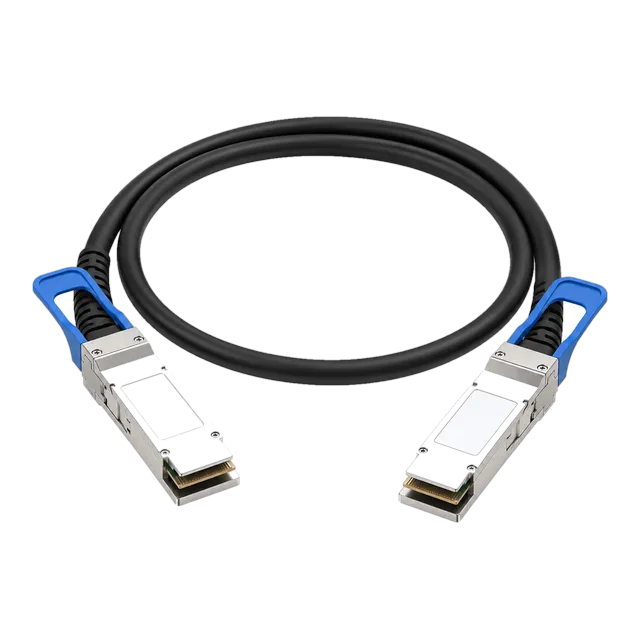
100G QSFP28 to QSFP28 Passive Direct Attach Copper Cable
- Data Rate100G
- ConnectorQSFP28 to QSFP28
- TypePassive Direct Attach Copper (DAC)


DAC & AOC Cable · 2 models
Direct attach copper and active optical cables for short rack links, including 100G QSFP28 passive DAC at 1 to 5 m and 10G SFP+ AOC to 20 m. Enquire now.
Buying guide
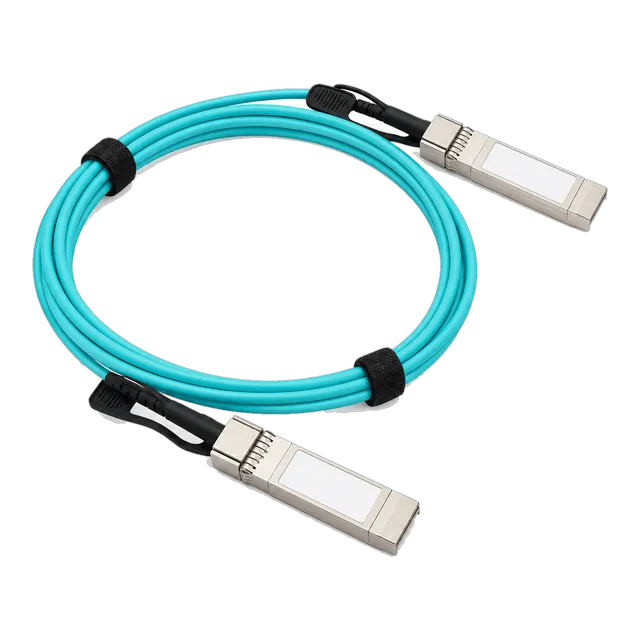
Direct attach cables replace a pair of transceivers and a patch lead with a single assembly that has the connector body moulded onto each end. Inside a rack that removes two mating points, two modules and a length of loose fibre from every link, which lowers cost, reduces power draw and makes cabling tidier. Two types exist. A direct attach copper cable, or DAC, uses twinax copper and is passive, so it consumes almost no power and is limited to a few metres. An active optical cable, or AOC, terminates multimode fibre in permanently attached optical ends, which costs more but carries the link further and is far lighter in a congested cable tray.
The assemblies listed in this category cover the two most common cases. The first is a 100G QSFP28 to QSFP28 passive DAC, offered in one, three and five metre lengths with AWG30, AWG28 and AWG26 conductors, intended for top-of-rack switch-to-switch and switch-to-server links. The second is a 10G SFP+ to SFP+ active optical cable built on OM3 multimode fibre with VCSEL optics, offered from two to twenty metres. Both are rated from 0 to 70 degrees Celsius and custom lengths can be quoted.
Because a cable assembly is fixed at both ends, the two things to settle before ordering are the exact length required including the slack for cable management, and the coding each end has to present to its host switch.
Models
Filter the family, then open a model for the full specification table, illustrations and ordering information.
Selection
Which assembly suits which rack link, based on the builds in this range.
| Requirement | Assembly type | Typical length | Notes |
|---|---|---|---|
| 100G switch to switch in the same rack | QSFP28 passive DAC | 1 m | AWG30 conductors, the most flexible build |
| 100G switch to server in the same rack | QSFP28 passive DAC | 3 m | AWG28 conductors, common top-of-rack length |
| 100G link to the adjacent rack | QSFP28 passive DAC | 5 m | AWG26 conductors, heavier and stiffer to route |
| 10G link beyond copper reach | SFP+ AOC on OM3 | 2 to 10 m | VCSEL optics, light and easy to dress |
| 10G link across a row | SFP+ AOC on OM3 | up to 20 m | Keeps weight down where trays are full |
| Non-standard runs | DAC or AOC | Quoted per project | Custom lengths available; confirm before ordering |
Listed values describe the published range. Confirm the exact model datasheet, host coding and installed link before ordering.
Before you order
A cable assembly cannot be shortened or extended on site, so the length has to be right first time. Measure the path the cable will actually follow through the cable manager, down the side of the rack and back up to the port, and add slack for the bend radius at each end and for sliding a server out on its rails. Ordering one length longer than the straight-line distance is normal practice. Too much slack, however, creates congestion in the tray and blocks airflow at the rear of the rack.
Passive copper cables trade flexibility for distance. A one metre assembly uses thin AWG30 conductors and routes easily, while a five metre assembly uses heavier AWG26 to hold signal integrity and is noticeably stiffer. In a dense rack with tight cable management, that stiffness matters and can force a wider bend than the space allows. Where the run is long enough to need heavy gauge but the routing is tight, an active optical cable is usually the more practical answer.
Each end of a direct attach or active optical cable presents module identification to the switch it plugs into, exactly as a transceiver does. When the two ends connect different platforms, both codings have to be specified on the order, because a cable coded only for one vendor may be rejected at the other end. State the switch model and software release for each end at the enquiry stage. Cables cannot be recoded after manufacture in the way a spare module can be swapped.
Direct attach and active optical cables suit fixed links between equipment that is unlikely to move. Once a rack is re-patched frequently, a structured cabling approach with transceivers and patch leads is easier to manage, because a failed patch lead costs less than a failed assembly and a change of port does not mean a change of cable. Assemblies also cannot be broken out at a patch panel, so plan them against a rack layout that is expected to stay stable.
FAQ
A direct attach copper cable carries the signal on twinax copper and is passive, so it uses almost no power but is limited to a few metres. An active optical cable has optical transceivers permanently attached to a fibre, so it costs more and needs a little power, but carries the link much further and weighs far less in a full cable tray. Copper for in-rack links, optical for longer runs.
The QSFP28 passive assemblies listed here are offered at one, three and five metres, with heavier conductor gauges used on the longer lengths to hold signal integrity. Passive copper does not extend much beyond that at 100G. Where a link needs more distance, an active optical cable or a pair of transceivers with a patch lead is the appropriate solution rather than a longer copper assembly.
Yes. Each end identifies itself to the host switch through stored module information, in the same way a transceiver does, and platforms differ in what they expect to see. When a cable joins two different switch platforms, specify the coding required at each end when ordering. State the switch model and software release for both ends, because a finished assembly cannot be recoded afterwards.
Yes, provided each end is coded for the platform it plugs into and both ports are specified for the same rate and form factor. The optical path inside the cable is fixed and does not care about the brands at either end. What matters is that both switches accept the module identification presented to them, so confirm the coding requirement for each platform before the cable is built.
Related families
Next step
Send the host platform, the fibre you have and the distance you need. We will shortlist the models that actually work and quote them.