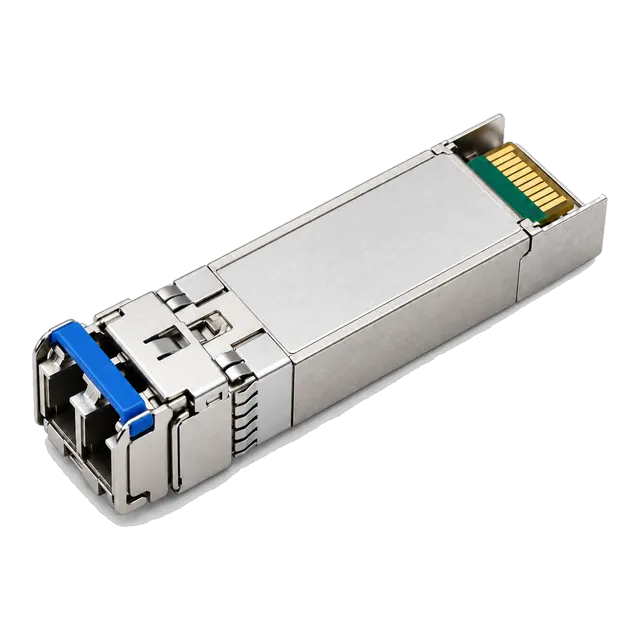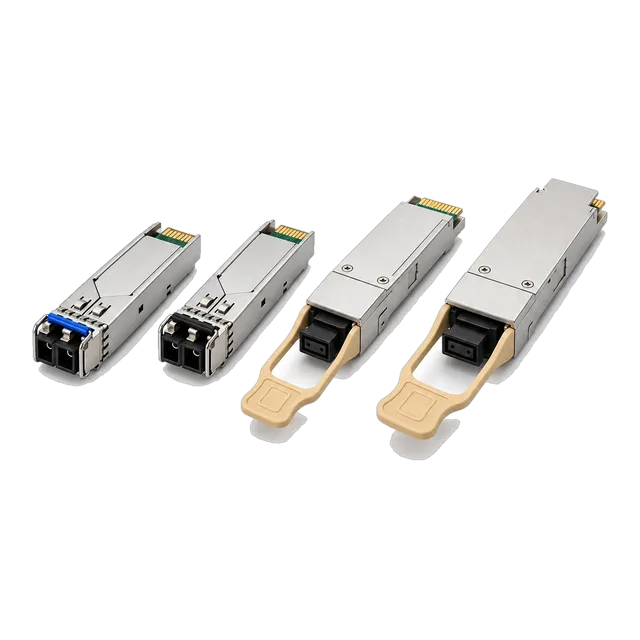
Optical Transceiver Module Series — SFP / SFP+ / SFP28
- Data Rate155M ~ 400G
- Wavelength850 ~ 1550nm
- Transmission Distance100m ~ 200km


Multi-Rate & Other · 2 models
Multi-rate optical transceiver series spanning SFP, SFP+, SFP28, QSFP+ and QSFP28 form factors from 155M upward, with DDM and OEM coding. Enquire now.
Buying guide
This category holds the cross-rate series entries rather than a single product type. They exist for buyers who are sourcing a mixed list, for example a project that needs Gigabit access optics, 10G uplinks and 25G or 100G switch interconnects at the same time, and who would rather agree a specification family than compile the list module by module. The entries describe the range as a whole and are used as a starting point for a quotation.
The first entry covers the full module family across SFP, SFP+, SFP28, QSFP+ and QSFP28 form factors. Its published range spans 155 Mb/s upward, wavelengths from 850 to 1550 nm, distances from 100 m to 200 km, single-mode and multimode fibre, and LC, SC and MPO connectors. All modules run from 3.3 V, support digital diagnostics and are rated 0 to 70 degrees Celsius, with OEM coding available. The second entry covers the 25G SFP28 family specifically, listing SR, LR, ER and BiDi variants across multimode and single-mode fibre with an LC duplex interface.
Because these are series descriptions, nothing should be ordered from them directly. Each line of a project list needs the rate, form factor, wavelength, reach class, fibre type, connector and host platform coding fixed individually, and the resulting part list confirmed in writing before manufacture. Where a variant matters to the design, check the specific category page for it as well.
Models
Filter the family, then open a model for the full specification table, illustrations and ordering information.
Selection
How the series maps onto form factor and rate, and where each part of it is detailed.
| Form factor | Data rate | Typical media | Where it is detailed |
|---|---|---|---|
| SFP | 155 Mb/s | Single-mode, LC or SC | See the 155M SFP category |
| SFP | 1.25 Gb/s | Multimode or single-mode, LC or SC | See the 1.25G SFP category |
| SFP | 2.5 Gb/s | Single-mode, LC | See the 2.5G SFP category |
| SFP+ | 10 Gb/s | Single-mode or multimode, LC | See the 10G SFP+ category |
| SFP28 | 25 Gb/s | Multimode or single-mode, duplex LC | See the 25G SFP28 category |
| QSFP+ | 40 Gb/s | MPO multimode or duplex LC single-mode | See the 40G QSFP+ category |
| QSFP28 | 100 Gb/s | MPO multimode or duplex LC single-mode | See the 100G QSFP28 category |
Listed values describe the published range. Confirm the exact model datasheet, host coding and installed link before ordering.
Before you order
These listings describe what a family can be built to, not a single item held to one specification. Two modules quoted from the same series can differ in wavelength, reach class, connector and coding, so an order placed against a series description alone invites a mismatch. Turn each line into a fixed specification covering rate, form factor, wavelength, reach, fibre type, connector and host coding, then confirm that list in writing. The detail pages for each rate exist for exactly this reason.
On a project that spans access, aggregation and data centre links, the temptation is to order by quantity and rate. That hides the variables that decide whether a link works: the fibre already installed, the strand count available, the measured loss on each route and the platform at each end. Build the list link by link, recording those four facts alongside the chosen module, and the same list then serves as the commissioning record and the basis for future spares.
Every pluggable module presents identification that the host switch reads, and different platforms expect different data. A project list that covers several switch vendors will need the same optical variant under more than one code, so record the switch model and software release for each end of each link when the list is compiled. Doing that at the quotation stage avoids receiving optically correct modules that a particular platform refuses to accept once they are in the rack.
The series specification quotes a commercial operating range of 0 to 70 degrees Celsius, which suits equipment rooms and data halls. Street cabinets, rooftop enclosures, trackside equipment and unconditioned plant rooms see wider swings, and an industrial grade part should be requested for those positions. Because a mixed project list frequently includes both kinds of location, mark the environment against each line rather than applying one grade across the whole order.
FAQ
It describes a family of modules across several form factors and rates rather than one product. The entries here span SFP, SFP+, SFP28, QSFP+ and QSFP28, wavelengths from 850 to 1550 nm, single-mode and multimode fibre, and LC, SC and MPO connectors, with digital diagnostics and OEM coding available. They are used as a starting point when a project needs several different module types quoted together.
No. A series listing sets out what can be supplied, not a fixed part. Each item has to be pinned down to a rate, form factor, wavelength, reach class, fibre type, connector and host coding before manufacture, and that specification should be confirmed in writing. The individual category pages for each rate carry the variant detail needed to turn a series enquiry into a definite list.
Work link by link rather than by quantity. For each link, record the fibre already installed, how many strands are available, the measured end-to-end loss and the switch platform at each end. Those four facts determine the wavelength, reach class, connector and coding for that link. The completed list then serves as the order, the commissioning reference and the basis for holding spares.
The series is quoted at a commercial range of 0 to 70 degrees Celsius, which covers equipment rooms and data halls. Positions with no environmental control, such as street cabinets, rooftop enclosures and trackside equipment, need an industrial grade part, so mark those lines when the list is compiled. State the installed environment for each link at the enquiry stage rather than applying a single grade to the whole order.
Related families
Next step
Send the host platform, the fibre you have and the distance you need. We will shortlist the models that actually work and quote them.