Copper SFP+ modules solve a real problem at the edge, but they draw far more power and add far more latency than optics or DAC, so use them where existing cabling makes them unavoidable.
01Why the question keeps coming up
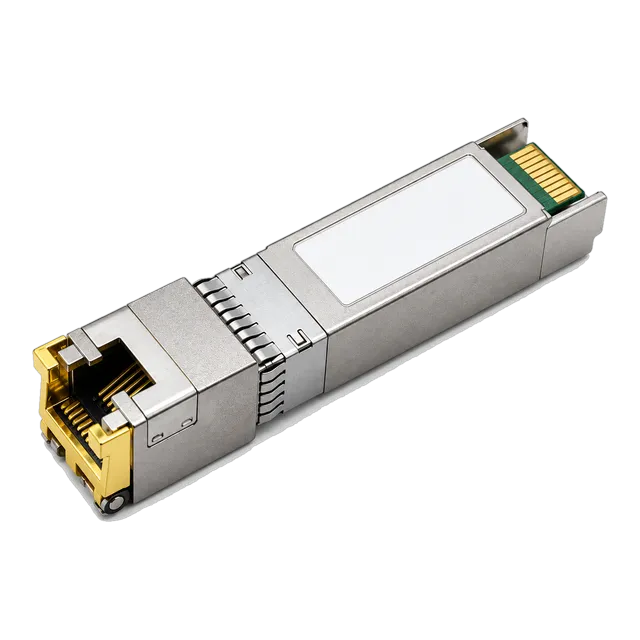
Most access-layer switches now ship with SFP or SFP+ cages rather than fixed copper ports, while the building they serve is wired with structured twisted-pair cabling that has years of service life left. The copper SFP module exists to bridge that gap: an RJ45 transceiver in an SFP or SFP+ form factor that lets a fiber-oriented switch terminate a copper run directly.
That convenience is real, but it is not free. A copper module performs a full PHY function inside a housing designed for a low-power optical transceiver, and the consequences appear as heat, power draw and latency rather than as a failure to link. Deciding between copper, optics, direct attach copper cable and active optical cable at the access layer is mostly a matter of understanding those consequences and matching them to the cabling you already own.
02What a copper SFP module actually does
An optical SFP+ module converts electrical serial data to light and back. A 10GBASE-T copper module does something considerably harder: it implements the complete 10GBASE-T physical layer, including a digital signal processor that performs echo cancellation and crosstalk cancellation across four bidirectional pairs, together with the block-coded forward error correction that makes 10 Gb/s over twisted pair possible at all.
The catalogue reflects this in the specifications. The 10G SFP+ copper RJ45 10GBASE-T module lists a 100 m reach over Cat6a or Cat7, 3.3 V supply, DDM support, hot-pluggable SFP+ form factor and a 0 to 70 °C operating range, with multi-rate auto-negotiation at 10G, 5G, 2.5G and 1G. The Gigabit equivalent, the SFP-1G-T 1000BASE-T module, covers 10, 100 and 1000 Mbps over 100 m of Cat5 or Cat6.
03Power: the constraint that decides most designs
A typical optical SFP+ transceiver dissipates on the order of one watt. A 10GBASE-T copper SFP+ module dissipates substantially more, because the signal processing required to run 10 Gb/s over four pairs cannot be done cheaply in energy terms. That is why several platforms restrict how many copper SFP+ modules may be fitted, why some restrict them to specific ports, and why the shorter-reach variants exist at all.
The catalogue lists 30 m, 80 m and 100 m 10GBASE-T copper modules precisely because shorter reach permits lower signal processing effort and therefore lower power. If a switch faceplate cannot dissipate a full row of copper modules, a 30 m variant for in-rack and in-room runs may fit the thermal envelope where a 100 m variant does not. Gigabit copper SFP modules are far less demanding and rarely cause the same problem.
04Heat, port density and neighbouring modules
Power dissipated in an SFP cage becomes heat in a confined space with limited airflow, and it warms the modules on either side. A switch that is comfortable with 24 optical SFP+ modules can run hot with 24 copper ones, and the first symptom is usually not a hard failure but intermittent link loss or errors that follow the ambient temperature through the day.
Before committing to a copper-module design, check three things in the host documentation: whether the platform supports 10GBASE-T SFP+ modules at all, how many may be fitted per switch or per port group, and whether any ports are excluded. Then check the installation environment: a wiring closet without active cooling in a warm climate removes exactly the margin the 0 to 70 °C rating assumes. Leaving alternate cages empty is a legitimate mitigation when density allows it.
05Latency: microseconds, and when they matter
10GBASE-T is a block-coded technology. The physical layer gathers data into large LDPC-coded blocks before transmission, and that framing imposes a fixed latency of roughly two microseconds in each direction, a figure built into the IEEE specification rather than a property of any particular module. Optical SFP+ links and passive direct attach copper cables are serial and add a fraction of a microsecond.
For general enterprise access, storage over a campus, video surveillance and most server connections, two microseconds is irrelevant against the latency of the application stack. For high-frequency trading, tightly coupled compute clusters, precision time distribution and some industrial control, it is not. If a design specifies latency in microseconds anywhere in its requirements, that is the point to eliminate 10GBASE-T from the access layer rather than to measure it afterwards.
06Cabling categories and honest reach
The reach of a copper link depends on the installed cable, not on the module. 1000BASE-T runs 100 m over Cat5e and better. 10GBASE-T is specified for 100 m over Cat6a and above; over Cat6 it is limited to a considerably shorter distance, commonly quoted at around 55 m and reduced further where cables are bundled tightly, because alien crosstalk between adjacent cables is the limiting mechanism rather than attenuation.
This matters most in retrofit projects. A building wired for Gigabit with Cat5e cannot carry 10GBASE-T at all, and one wired with Cat6 may carry it only on the shorter runs. Before specifying 10G copper modules for an existing plant, obtain the certification records for the links in question, or have them re-tested to the relevant category. The module cannot repair a cable that was never qualified for the rate.
07Auto-negotiation and multi-rate behaviour
Copper modules negotiate. The listed 10G SFP+ copper modules support 10G, 5G, 2.5G and 1G auto-negotiation, which is useful at the edge where devices vary, and occasionally troublesome because a link that should be 10G may settle at a lower rate on a marginal cable without anyone noticing. Fixed-speed optical links either work or do not, which is operationally simpler to diagnose.
Two practical habits help. First, monitor the negotiated speed rather than only the link state, so that a run that has degraded to 2.5G is visible in monitoring rather than discovered during an incident. Second, confirm that the host platform passes the negotiated rate through correctly on SFP+ ports; some switches require the port to be configured for a specific speed or for auto-negotiation explicitly, and the default behaviour is not consistent across platforms.
08Where DAC is the better answer
Inside a rack, a passive direct attach copper cable is usually superior to any module-plus-patch-cord combination. It is a fixed assembly with transceiver housings moulded onto each end, it dissipates very little power because it contains no active circuitry, and it adds negligible latency. The catalogue lists a 100G QSFP28 to QSFP28 passive DAC in AWG30, AWG28 and AWG26 gauges at 1 m, 3 m and 5 m, which is the typical envelope for passive assemblies.
The limits are length and flexibility. Passive DAC is practical to a few metres, thicker gauges are stiffer and harder to route in a dense cabinet, and the assembly cannot be re-terminated. DAC also carries EEPROM coding like any transceiver, so the same host compatibility questions apply at both ends, and both ends should be coded for the platforms they plug into.
09Where AOC fits between DAC and optics
An active optical cable replaces the copper conductors with fiber and puts the optical engines inside the moulded ends. The listed 10G SFP+ AOC uses VCSEL transmitters over OM3 multimode fiber in lengths from 2 m to 20 m and beyond. Compared with DAC it is thinner, lighter, more flexible in cable management, immune to electromagnetic interference and available at lengths copper cannot reach.
AOC suits row-to-row and cabinet-to-cabinet runs where a permanent point-to-point link is acceptable and where an MPO or LC structured path would be unnecessary overhead. Its drawback is that it is a fixed length with no serviceable ends: a damaged connector means replacing the whole assembly, and a change of layout may leave the cable the wrong size. Where the link may move or be patched, discrete optics and a structured fiber path remain more flexible.
10When fiber is the right access-layer answer
Fiber wins whenever distance exceeds 100 m, whenever the run leaves a building, whenever the path crosses an electrical environment with ground potential differences or heavy interference, and whenever power budget in the closet is tight. It also wins where the same link may need to be upgraded later: a single-mode pair that carries 1G today can carry 10G or 25G with a module change, whereas a copper run is tied to its category.
The catalogue covers the common cases, from 1.25G SFP modules at 10 and 20 km through 10G SFP+ BiDi variants at 20, 60, 80 and 100 km to 25G SFP28 SR and LR modules. Where a copper device must be reached over fiber, a media converter such as the 10/100/1000 Gigabit single-mode fiber media converter or the 2.5G fiber to Ethernet converter completes the path without adding a switch.
11A practical selection rule
Use passive DAC for links inside one rack up to a few metres. Use AOC for point-to-point links of roughly 5 to 20 m across adjacent racks where no patching is needed. Use optical SFP+ or SFP28 modules over structured fiber wherever the link is patched, is longer than a row, leaves the room, or must survive a later speed upgrade. Use 10GBASE-T copper SFP+ modules where certified Cat6a cabling already exists and the endpoint has a fixed RJ45 interface, and where the host supports the module in the quantity you intend to fit.
Use 1000BASE-T copper SFP modules freely at Gigabit, where power and latency are not meaningful constraints. The failure mode to avoid is filling an SFP+ switch with 10G copper modules simply because the building is wired with twisted pair.
12What to specify when you enquire
For copper modules, state the rate, the required reach and the cabling category actually installed, the host make, model and software version, whether DDM is required, and the temperature range of the location. For DAC and AOC, state the connector types at both ends, the exact length, the gauge if the routing is tight, and the host platform at each end, since the two ends may plug into different vendors' equipment.
For optics, state the fiber type, the route length, the connector type, whether the link is dual-fiber or single-fiber, and the host platform. In every case, record the intended port count per switch, because that is what determines whether the thermal and power envelope of the chassis supports the design. A clear enquiry avoids the most common access-layer disappointment, which is equipment that links but does not perform.
13Frequently asked questions
How much more power does a 10GBASE-T SFP+ module use?
Substantially more than an optical SFP+ transceiver, which typically dissipates around one watt. The copper module implements the full 10GBASE-T physical layer with echo and crosstalk cancellation, and that signal processing costs energy. Shorter-reach 30 m and 80 m variants exist because reduced reach allows reduced processing and therefore lower dissipation in the cage.
Can I use 10GBASE-T modules over Cat6 cabling?
Only over shorter runs. 10GBASE-T is specified for 100 m over Cat6a and above, while Cat6 supports it to a considerably shorter distance, commonly quoted around 55 m and reduced further in tightly bundled cable where alien crosstalk is worse. Cat5e does not support 10GBASE-T. Check the link certification records before specifying modules.
Does 10GBASE-T add meaningful latency?
It adds roughly two microseconds per direction because the physical layer processes data in large coded blocks. Optical SFP+ links and passive DAC add a fraction of a microsecond. For enterprise access, surveillance and general server connectivity this is immaterial; for trading systems, tightly coupled compute and some industrial control it is enough to rule copper out.
Is DAC or AOC better for connecting adjacent racks?
Passive DAC is best within a rack up to a few metres, where it costs almost no power and adds almost no latency. Beyond that, AOC is usually the better choice: it is thinner, more flexible, immune to electromagnetic interference and available in longer lengths such as the 2 m to 20 m range of the listed 10G SFP+ AOC. Neither can be re-terminated.
Do copper SFP modules need to be coded for the switch?
Yes. Like optical transceivers, copper modules carry EEPROM identification that the host reads, and many platforms check it before enabling the port. Provide the host make, model and software version so the module can be coded for that platform, and confirm the host supports 10GBASE-T modules and in what quantity, since some platforms limit them.
Technical review note: confirm model-specific specifications with the product datasheet and the intended host documentation. Product images and application photographs are illustrative.
Discuss this with our team