Choose unmanaged switches for transparent point-to-point edge links, but specify managed switches whenever your topology requires IEEE 802.1Q VLAN segmentation, Rapid Spanning Tree redundancy, SFF-8472 optical diagnostics, or deterministic traffic control.
01What is the core technical difference between managed and unmanaged switches?
The core technical difference in a managed vs unmanaged ethernet switch comparison is the presence of an active control plane and administrative interface. An unmanaged switch operates purely at the data plane using fixed hardware logic: its application-specific integrated circuit (ASIC) reads incoming Layer 2 Ethernet frames, populates a Media Access Control (MAC) address forwarding table using standard IEEE 802.3 auto-negotiation, and bridges packets between ports with no user intervention. By contrast, a managed switch integrates a local microprocessing subsystem running an embedded operating system, giving network engineers complete oversight and deterministic control over packet processing, queue management, and physical port states.
In enterprise and industrial deployments, deciding between a unmanaged ethernet switch and a fully configurable alternative dictates how your topology responds to faults. Unmanaged units provide fixed, unalterable bridging functions, making them transparent plug-and-play appliances. A managed switch incorporates configurable software daemons that support network telemetry, Simple Network Management Protocol (SNMPv1/v2c/v3), secure management via SSH, and telemetry export. As explored in our managed switch procurement guide, having control plane intelligence allows teams to isolate broadcast domains, configure port mirroring for external packet analysers, and apply granular Quality of Service (QoS) scheduling algorithms across multi-gigabit backplanes.
02How does data plane forwarding differ in a network switch managed vs unmanaged?
Data plane forwarding in a network switch managed vs unmanaged implementation differs not in baseline wire-speed throughput, but in how internal hardware lookup tables classify and prioritize incoming traffic. Both switch variants utilise store-and-forward or cut-through switching fabrics capable of line-rate forwarding—delivering 1.488 million packets per second (Mpps) per Gigabit Ethernet port per IEEE 802.3ab specifications. However, an unmanaged switch forwards frames strictly based on the unweighted destination MAC address lookup in its static Content Addressable Memory (CAM) table.
When congestion occurs on an unmanaged switch, the device relies solely on standard IEEE 802.3x flow control pause frames, treating bulk file transfers, security video streams, and low-latency industrial automation commands with identical, best-effort priority. In contrast, a managed switch evaluates frame headers down to Layer 2 Class of Service (IEEE 802.1p CoS) or Layer 3 Differentiated Services Code Point (DSCP) values. The internal ASIC routes frames into discrete hardware egress queues (typically 4 to 8 priority queues per port) using algorithms such as Strict Priority (SP) or Weighted Round Robin (WRR), preventing high-throughput data bursts from starving mission-critical control traffic.
03VLAN isolation and security: why managed switches are mandatory for segmented networks
Managed switches are mandatory for segmented networks because unmanaged switches cannot interpret, enforce, or isolate IEEE 802.1Q virtual local area network (VLAN) boundaries. An unmanaged switch functions as a single broadcast domain; any broadcast, unknown unicast, or multicast frame received on one port floods across every other active port on the unit. This flat architecture exposes connected endpoints to eavesdropping, packet sniffing, and lateral malware traversal.
A managed switch provides robust traffic isolation by allowing engineers to carve a physical chassis into multiple logical broadcast domains using 12-bit IEEE 802.1Q VLAN tags (supporting up to 4,094 distinct VLAN IDs). Key security mechanisms configurable only on managed devices include:
- Port Security (MAC Limiting): Restricts ingress traffic to specific learned or statically assigned MAC addresses, automatically disabling the interface if an unauthorised physical host attaches.
- Access Control Lists (ACLs): Layer 2 through Layer 4 packet filtering rules based on source/destination MAC, IP address, or TCP/UDP port numbers.
- Dynamic ARP Inspection (DAI) and DHCP Snooping: Drops invalid Address Resolution Protocol requests and blocks rogue DHCP servers by validating messages against a trusted binding database.
- Private VLANs (PVLANs): Isolates downstream edge ports from one another while allowing upstream traffic over a shared promiscuous gateway link.
04Loop prevention protocols: RSTP and MSTP vs unmanaged loop vulnerability
Managed switches actively prevent catastrophic network loops through standardised spanning tree protocols, whereas unmanaged switches will collapse into an unrecoverable broadcast storm if a physical loop is formed. In any switched topology containing redundant physical links, broadcast frames multiply exponentially across interconnected forwarding ports. Because standard Ethernet frames lack a Time to Live (TTL) field, looped frames circulate indefinitely, saturating switch backplanes and exhausting ingress packet buffers within milliseconds.
Managed switches mitigate this vulnerability by running distributed loop-prevention algorithms:
- Rapid Spanning Tree Protocol (IEEE 802.1w RSTP): Continuously exchanges Bridge Protocol Data Units (BPDUs) between peer switches to construct a loop-free logical forwarding tree, blocking redundant links and achieving convergence in under 200 ms during a link failure.
- Multiple Spanning Tree Protocol (IEEE 802.1s MSTP): Maps multiple logical VLANs to individual spanning tree instances, facilitating Layer 2 load balancing across redundant optical uplinks.
- Industrial Ring Protocols: Proprietary and open standards like ITU-T G.8032 Ethernet Ring Protection Switching (ERPS) that guarantee sub-50 ms failover recovery over mission-critical fibre rings.
An unmanaged switch cannot process BPDUs and will either drop them or flood them blindly, meaning an accidental patching loop requires a technician to physically disconnect cables to restore connectivity.
05Optical link telemetry: DDM and DOM support in managed vs unmanaged ethernet switch builds
Optical link telemetry through Digital Diagnostic Monitoring (DDM) requires a managed switch control plane to read, interpret, and export physical layer operational values from transceivers. In a managed platform, the internal I2C serial bus communicates with the SFP module's internal microchip at device address A2h as defined by the SFF-8472 industry standard. This architecture grants operators real-time visibility into vital optical parameters.
A managed switch platform extracts five mandatory optical parameters from compliant pluggable modules:
- Transceiver Temperature: Internal operating temperature measured in degrees Celsius (°C), alerting to chassis fan failures or enclosure overheating.
- Supply Voltage: Internal operating voltage (nominal 3.3 V DC) monitored down to millivolt resolution.
- Laser Bias Current: Transmitter laser diode injection current in milliamperes (mA), providing predictive indication of transmitter degradation.
- TX Optical Power: Transmitted optical launch power measured in microwatts (µW) or decibels relative to one milliwatt (dBm).
- RX Optical Power: Received optical power at the photodiode detector in dBm, essential for verifying attenuation across deployed single-mode fiber links.
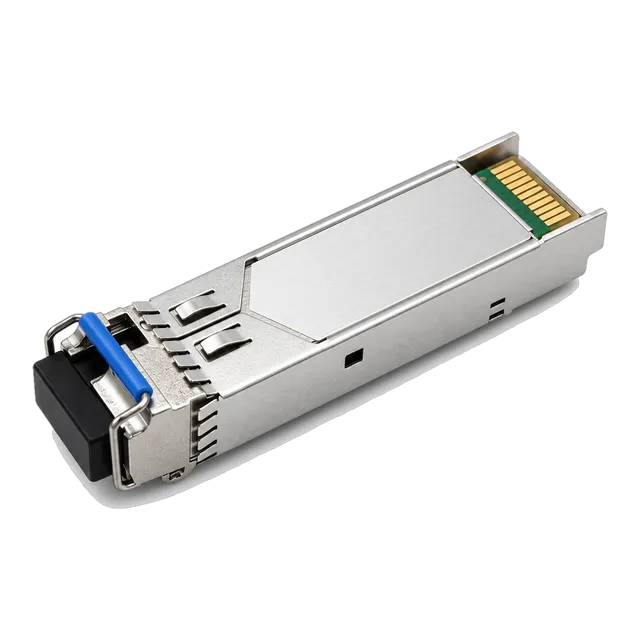
Unmanaged switches provide no management processor to read address A2h. Even if you populate an unmanaged switch with advanced transceivers—such as our 1.25G Gigabit SFP Transceiver with DDM—the switch cannot report link margins or trigger automated alarms when optical power drops below the receiver sensitivity threshold.
06Should you deploy a managed or unmanaged ethernet switch at the industrial edge?
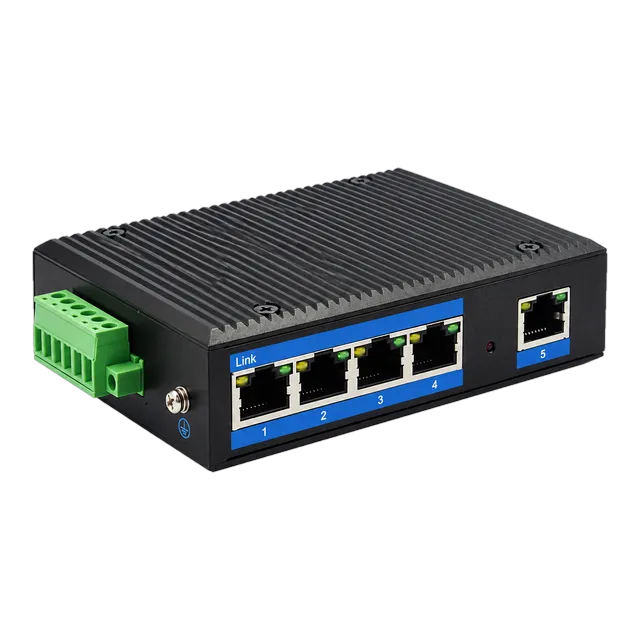
Deploying a managed or unmanaged ethernet switch at the industrial edge depends on whether your field nodes require isolated data paths and remote diagnostics or purely physical connectivity to an upstream aggregation node. In ruggedised environments like power substations, roadside surveillance cabinets, and factory automation cells, unmanaged switches often serve effectively as cost-effective terminal distribution blocks. Units such as our Outdoor Industrial Gigabit Ethernet Switch deliver hardened -40°C to +85°C thermal resilience, dual 10~47V DC power inputs, and shock/vibration tolerance without adding configuration overhead or software vulnerability surfaces.
However, when field devices include IP security cameras carrying sensitive footage alongside Programmable Logic Controllers (PLCs) executing PROFINET or EtherNet/IP commands, a managed switch becomes unavoidable. Without IEEE 802.1Q segmentation, high-bandwidth camera streams easily saturate automation channels. Furthermore, remote utility sites with zero on-site IT personnel benefit massively from managed features like Syslog generation, remote port power-cycling over PoE, and Link Layer Discovery Protocol (LLDP / IEEE 802.1AB) to track downstream physical plant cabling.
07Architectural comparison: features, protocols, and performance metrics
A direct technical comparison reveals distinct protocol support and architectural capabilities across unmanaged, smart (lightly managed), and fully managed switches. Selecting the proper tier prevents both operational bottlenecks and procurement over-expenditure.
| Functional Feature / Protocol | Standard Unmanaged Switch | Smart-Managed (Web-Only) | Fully Managed (L2/L3 Enterprise) |
|---|---|---|---|
| VLAN Support (IEEE 802.1Q) | None (Single Domain) | Basic Port/Tag-Based (up to 64-128) | Full 4,094 VLANs, Q-in-Q (802.1ad) |
| Spanning Tree (STP/RSTP/MSTP) | None (Floods BPDUs) | IEEE 802.1w RSTP | IEEE 802.1D, 802.1w RSTP, 802.1s MSTP |
| Multicast Filtering | Floods as Broadcast | IGMPv1/v2 Snooping | IGMPv1/v2/v3 Snooping, MLD Snooping |
| Management Interfaces | None | Web GUI, basic HTTP/HTTPS | SSHv2, Telnet, Console (RS-232), SNMPv3 |
| Diagnostic Telemetry | Chassis Link/Activity LEDs | Port link states, packet counters | SFF-8472 DDM/DOM, RMON, sFlow/NetFlow |
| Port Aggregation (Link Aggregation) | None | Static LAG | IEEE 802.3ad LACP dynamic trunking |
| Average Boot-to-Traffic Latency | Under 3 seconds | 15 to 30 seconds | 45 to 120 seconds |
| Typical Relative Hardware Cost | 1.0x (Baseline) | 1.8x to 2.5x | 3.5x to 8.0x |
This comparison shows that smart-managed switches bridge the gap for mid-tier deployments, offering basic VLAN tagging and RSTP recovery without the full software licensing costs and configuration complexity of enterprise Layer 3 command-line platforms.
08Worked calculation: optical link budget and packet loss analysis
Calculating optical power margins and queue fill times reveals why managed switches prevent silent data loss across high-capacity links. Consider an industrial aggregation node linking back to a core data centre using a pair of single-mode transceivers across a 20 km field run. We will determine optical headroom using standard ITU-T G.652 single-mode fibre characteristics and calculate buffer drain time under an unmanaged traffic spike.
Step 1: Optical Link Budget Calculation
- Transmitter minimum launch power ($P_{TX\_min}$): -9.0 dBm (using a standard 1000BASE-LX 1310 nm optic)
- Receiver sensitivity threshold ($P_{RX\_sens}$): -20.0 dBm
- Total Optical Power Budget ($B$): $B = P_{TX\_min} - P_{RX\_sens} = -9.0\text{ dBm} - (-20.0\text{ dBm}) = 11.0\text{ dB}$
- Channel loss: $20\text{ km} \times 0.35\text{ dB/km} = 7.0\text{ dB}$
- Connector losses: 2 mated pairs at $0.4\text{ dB}$ each = $0.8\text{ dB}$
- Splice losses: 4 fusion splices at $0.05\text{ dB}$ each = $0.2\text{ dB}$
- Total Link Attenuation ($A$): $7.0 + 0.8 + 0.2 = 8.0\text{ dB}$
- Safety Operating Margin ($M$): $M = B - A = 11.0\text{ dB} - 8.0\text{ dB} = 3.0\text{ dB}$
On a managed switch, SFF-8472 telemetry reads continuous RX levels. If an optical bend adds 3.5 dB attenuation, RX drops to -20.5 dBm; the managed platform immediately generates an SNMP trap alerting the NOC before bit error rates spike. An unmanaged switch simply drops links unpredictably.
Step 2: Buffer Drain and Congestion Calculation
Assume four 1 Gbps access ports forward simultaneously into a single 1 Gbps optical uplink port. The switch contains a shared packet buffer of 512 kilobytes ($512 \times 1024 \times 8 = 4,194,304\text{ bits}$). Ingress traffic arrives at a combined 4 Gbps while egress exhausts at 1 Gbps, yielding a net accumulation rate of 3 Gbps ($3 \times 10^9\text{ bits/second}$).
Buffer exhaustion time ($T_{fill}$):
$$T_{fill} = \frac{4,194,304\text{ bits}}{3 \times 10^9\text{ bps}} \approx 0.001398\text{ seconds} = 1.40\text{ milliseconds}$$
Within 1.40 ms, the unmanaged switch buffer completely overflows, tail-dropping all subsequent frames indiscriminately. A managed switch applies Weighted Random Early Detection (WRED) and IEEE 802.1Qbb Priority-based Flow Control (PFC) to selectively throttle non-critical flows while preserving latency-sensitive frames.
09PoE orchestration: managing remote powered devices
Managed PoE switches provide active power profiling, port scheduling, and watchdog functionality that unmanaged PoE hardware cannot deliver. An unmanaged Power over Ethernet switch allocates wattage based on basic hardware negotiation conforming to IEEE 802.3af (15.4 W) or IEEE 802.3at (30 W PoE+). If you attach powered devices (PDs) whose cumulative nameplate ratings exceed the power supply unit (PSU) capacity, the unmanaged switch typically shuts down ports haphazardly or brownouts entirely.
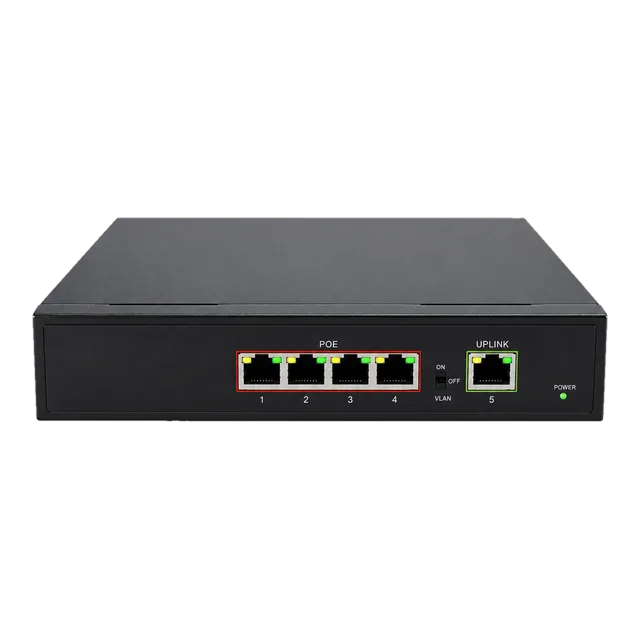
Deploying compact hardware such as our Gigabit PoE IP Ethernet Switch delivers reliable edge power for dedicated camera clusters. However, when large multi-port topologies are required, managed PoE infrastructure introduces three essential engineering controls:
- Dynamic Power Budgeting: Reads the precise instantaneous power consumption of attached devices over Layer 2 LLDP-MED packets, reallocating unutilised reserve watts to other ports rather than locking out capacity based on theoretical maximum ratings.
- Automated Device Ping Watchdog: Periodically transmits ICMP echo requests to the IP address of an attached device (such as an edge access point or camera); if the device fails to respond within a programmed timeout, the switch automatically cycles DC power to that specific port to hard-reboot the frozen endpoint.
- Time-Based Scheduling: Disables PoE delivery to specific ports outside operational hours to curtail energy expenditure and prevent unauthorized night-time access to physical network jacks.
10Troubleshooting, link aggregation, and remote MTBF preservation
Managed switches dramatically reduce Mean Time to Repair (MTTR) by providing comprehensive remote diagnostic tools that eliminate costly physical site dispatches. When an edge link experiences intermittent packet drops on an unmanaged switch, network technicians must travel to the cabinet with handheld optical time-domain reflectometers (OTDRs) and cable testers, methodically unplugging ports to trace the fault while disrupting operational network traffic.
Managed switches resolve connectivity degradation through integrated remote utilities:
- Switched Port Analyzer (SPAN / Mirroring): Duplicates ingress and egress traffic from any physical port or VLAN to an internal diagnostic port running packet capture tools like Wireshark without breaking the production link.
- Time-Domain Reflectometry (TDR) Cable Diagnostics: Measures reflections across copper pairs directly from the switch CLI, locating cable opens, shorts, and split pairs down to the exact metre mark.
- IEEE 802.3ad Link Aggregation Control Protocol (LACP): Combines up to eight physical interfaces into a single logical trunk. If an optical transceiver fails on one physical path, LACP dynamically redistributes packet flows across surviving trunk members in under 10 milliseconds, preserving link availability while alerting systems administration via Syslog.
11Procurement checklist: technical specifications for engineering RFQs
A structured procurement checklist ensures that your Request for Quotation (RFQ) specifies the exact switching capabilities required for your installation without incurring unnecessary feature licensing costs. Use the criteria below when compiling purchase requisitions for edge, aggregation, and industrial switches.
| Engineering Criteria | Unmanaged Switch Specification | Managed Switch Specification |
|---|---|---|
| Layer 2 Protocols | IEEE 802.3u/ab auto-negotiation, 802.3x full-duplex flow control | IEEE 802.1Q (VLAN), 802.1p (CoS), 802.1w (RSTP), 802.3ad (LACP) |
| Multicast Management | Unconstrained L2 flooding acceptable | IGMPv2/v3 Snooping with dynamic querier support |
| Optics & SFP Support | Fixed SFP cages, baseline 1000BASE-SX/LX transceiver compatibility | SFF-8472 DDM/DOM reading, real-time optical threshold alarms |
| Management & Security | None required (Zero IP footprint) | SSHv2, SNMPv3, RADIUS/TACACS+ 802.1X, Port Security |
| Hardware MTBF | > 500,000 hours (Telcordia SR-332) | > 350,000 hours (inclusive of CPU subsystem) |
| Operating Temperature | Commercial: 0 to 50°C; Industrial: -40 to 85°C | Commercial: 0 to 50°C; Industrial: -40 to 85°C |
| Power Delivery | IEEE 802.3af/at auto-sensing PSU | LLDP-MED dynamic budget allocation, port watchdog reboot |
To review interoperable transceiver options across single-mode and multimode fibre topologies, consult our guide to switches for fiber optic networks to ensure compatible physical uplinks across your switch infrastructure.
12Deploying the right switch tier across your network architecture
Deploying the right switch tier requires mapping your network's functional zones to the minimum operational and management requirements of each segment. Rather than standardising exclusively on expensive enterprise managed switches or restricting field designs to basic unmanaged hardware, the most cost-effective and resilient industrial networks deploy a hybrid architectural hierarchy.
Position unmanaged switches at the extreme edge of your network—such as inside isolated machine control panels, point-to-point laboratory test benches, or simple small-office printer workgroups—where traffic flows are static, predictable, and confined to a single broadcast domain. Conversely, place fully managed switches at all network core, distribution, and cross-facility aggregation points. This guarantees that your core infrastructure handles routing, prioritises business-critical voice and automation traffic, contains physical loop failures, and continuously logs physical transceiver health via SFF-8472 diagnostics.
13Frequently asked questions
Can an unmanaged switch work with VLANs?
An unmanaged switch cannot create or isolate VLANs. While some unmanaged switches will transparently pass IEEE 802.1Q tagged frames without stripping the tag, they cannot enforce VLAN separation. All connected devices remain in a single broadcast domain, meaning unmanaged switches cannot isolate subnets or prevent cross-VLAN eavesdropping.
Does a managed switch offer faster speeds than an unmanaged switch?
No, a managed switch does not offer higher raw throughput than an unmanaged switch with the same port ratings. Both deliver line-rate wire speeds per IEEE 802.3 standards. However, managed switches perform better under heavy congestion because Quality of Service (QoS) prioritises mission-critical traffic over bulk data.
Why does an unmanaged switch cause broadcast storms?
An unmanaged switch causes broadcast storms when redundant physical cables create a network loop. Because unmanaged switches lack loop-prevention protocols like IEEE 802.1w Rapid Spanning Tree Protocol (RSTP), broadcast frames circulate and multiply indefinitely across the bridging fabric, rapidly exhausting switch backplane bandwidth and dropping all valid network traffic.
Can you access Digital Diagnostic Monitoring on an unmanaged switch?
No, you cannot access SFF-8472 Digital Diagnostic Monitoring (DDM) data on an unmanaged switch. Unmanaged units lack the management CPU and internal software stack required to read transceiver telemetry over the I2C bus. Consequently, parameters such as optical receive power, laser bias current, and operating temperatures cannot be monitored.
When is an unmanaged switch preferred over a managed switch?
An unmanaged switch is preferred for small, non-critical networks, isolated test benches, or field endpoints requiring zero configuration. They boot instantly in under 3 seconds, cost significantly less, possess no software vulnerability surfaces that require firmware patching, and offer exceptionally high mean time between failures due to simpler hardware circuitry.
Technical review note: confirm model-specific specifications with the product datasheet and the intended host documentation. Product images and application photographs are illustrative.
Discuss this with our team