Gigabit PoE IP Ethernet Switch — 4 PoE Ports + 1 Uplink
- PoE Ports4 × 10/100/1000Mbps
- Uplink Port1 × 1000M RJ45
- StandardIEEE 802.3af/at


Ethernet Switch · 2 models
Gigabit Ethernet switches for surveillance and harsh environments, including a 4-port PoE switch with uplink and a 5-port industrial DIN-rail model. Enquire.
Buying guide
An Ethernet switch sits at the edge of most surveillance, access and small-site networks, joining cameras, access points, phones and controllers to an uplink. The two units in this category are unmanaged Gigabit designs chosen for particular jobs rather than for a general office network, and they answer two very different questions: how to power devices over the data cable, and how to keep a link running in a location with no environmental control.
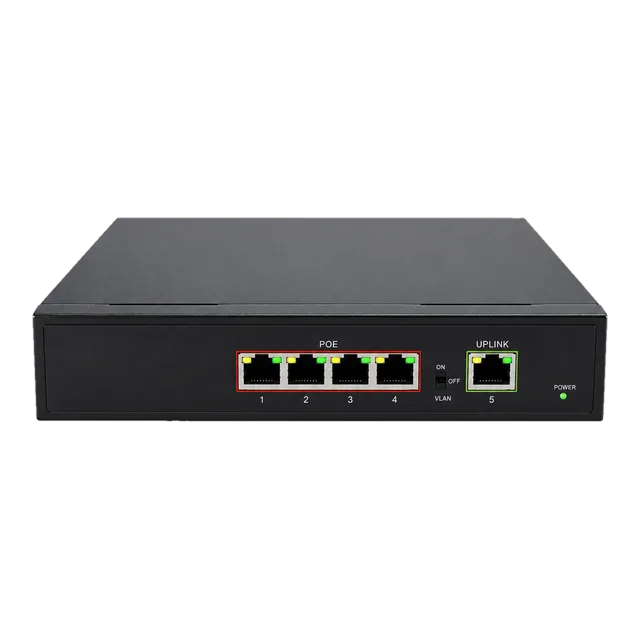
The first is a Gigabit PoE switch with four 10, 100 and 1000 Mb/s PoE ports and one Gigabit RJ45 uplink. The PoE ports follow IEEE 802.3af and 802.3at and supply up to 30 W each, with a 52 V 65 W total input, which makes it suited to a cluster of IP cameras, wireless access points or VoIP handsets fed from one point. It holds an 8K MAC address table, works from minus 10 to 55 degrees Celsius and comes in a metal housing.
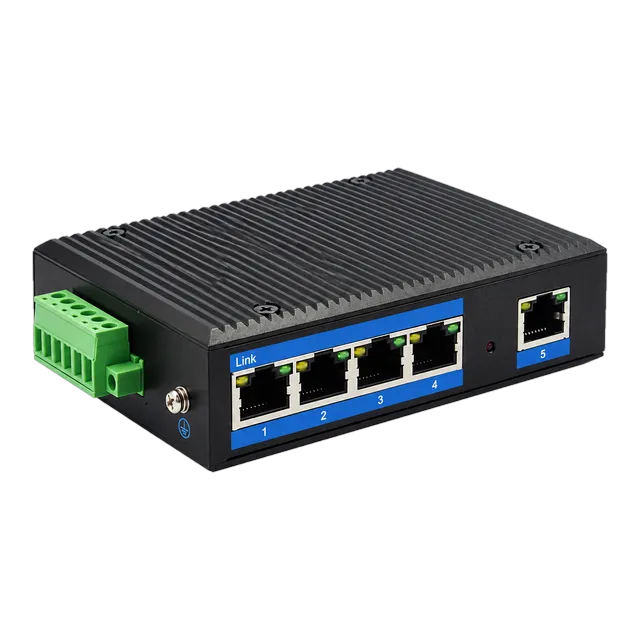
The second is an outdoor industrial switch with five 10, 100 and 1000BASE-T ports in an aluminium alloy housing. It accepts a wide 10 to 47 V DC input, works from minus 40 to 85 degrees Celsius and mounts on DIN rail or a wall, which suits roadside cabinets, factory floors, solar and energy sites and telecom enclosures, and PoE is available as an option on this model. In either case, specify the port count, the power delivery required, the input voltage available at the site, the mounting method and the temperature range the unit has to survive.
Models
Filter the family, then open a model for the full specification table, illustrations and ordering information.
Selection
Matching a requirement to the switch model that meets it.
| Requirement | Model that fits | Key specification |
|---|---|---|
| Powering IP cameras over the data cable | Gigabit PoE switch | 4 PoE ports, IEEE 802.3af and 802.3at, up to 30 W each |
| A separate path back to the router | Gigabit PoE switch | One dedicated 1000 Mb/s RJ45 uplink port |
| Installation in an unheated outdoor cabinet | Outdoor industrial switch | Operating range of minus 40 to 85 degrees Celsius |
| Mounting inside a control or telecom cabinet | Outdoor industrial switch | DIN-rail or wall mount with screw terminal input |
| Supply from a solar, battery or vehicle source | Outdoor industrial switch | Wide 10 to 47 V DC input range |
| Five Gigabit copper ports without PoE | Outdoor industrial switch | 5 x 10/100/1000BASE-T, PoE available as an option |
| A rugged metal enclosure for exposed sites | Either model | Metal housing, aluminium alloy on the industrial unit |
Listed values describe the published range. Confirm the exact model datasheet, host coding and installed link before ordering.
Before you order
A switch has both a per-port limit and a total power budget, and the total is the one that is usually reached first. The PoE model here supplies up to 30 W per port from a 52 V 65 W input, so four ports cannot all draw their maximum at once. Work from the class of each powered device and its peak draw rather than its idle figure, since infrared illuminators, heaters and pan-tilt motors raise consumption sharply in cold weather or at night, which is exactly when the cameras are needed.
A switch in a roadside cabinet, a factory or a rooftop enclosure sees temperature swings, vibration and unstable power that a commercial unit is not built for. The industrial model is specified from minus 40 to 85 degrees Celsius with a wide DC input and an aluminium alloy housing for that reason. Choosing on port count alone and installing a commercial switch outdoors is a common cause of intermittent faults that only appear in the coldest or hottest weeks of the year.
Every copper port is limited to 100 m, which includes patch leads at both ends, so a camera more than about 90 m from the switch needs the switch moved closer or the link converted to fibre. The PoE model provides a separate Gigabit uplink so access traffic and the return path do not compete for the same port. Where the uplink itself exceeds copper reach, a media converter or a switch with a fibre port is the usual way to complete the run.
Both units are unmanaged, which means no VLANs, no port mirroring, no link aggregation and no remote statistics. For a small camera cluster or a remote cabinet that is usually the point, since there is nothing to configure and nothing to misconfigure. Where traffic has to be segmented, where port-level visibility is needed for fault finding, or where the site is part of a larger monitored network, a managed switch belongs in the design instead.
FAQ
Four, one per PoE port, but the total power budget matters as much as the port count. The model here supplies up to 30 W per port from a 52 W class input, so four high-draw cameras with heaters or illuminators can exceed the total even though each is within its port limit. Add up the peak class of every device before assuming all four ports can run fully loaded.
Environment. An industrial switch is built for locations with no climate control, so it uses a wide DC input, a fanless metal housing and a much wider temperature range, and it mounts on DIN rail or a wall rather than a rack shelf. The model here is specified from minus 40 to 85 degrees Celsius, which suits outdoor cabinets, factories, solar sites and telecom enclosures.
No. Both are unmanaged, so they forward traffic as soon as they are powered and connected, with no console, no address to set and nothing to configure. The trade-off is that there are no VLANs, no port statistics and no remote management. Where a site needs traffic segmentation or remote visibility for fault finding, a managed switch should be specified instead.
PoE is listed as an option on the industrial model rather than as standard, so it has to be specified when ordering. If powered devices are part of the design, state the number of ports that need PoE and the class of each device at the enquiry stage, along with the DC supply voltage available at the site, since the input range is 10 to 47 V DC.
Related families
Next step
Send the host platform, the fibre you have and the distance you need. We will shortlist the models that actually work and quote them.